
School Trust Lands
Alaska
Alaska is the cleanest twentieth-century example of the road not taken. Every other state in this Briefing Room entered the Union under some version of the section-grant template — sections 16 and 36 (and after 1894, also sections 2 and 32) reserved in every surveyed township for the support of common schools, with state constitutional architecture grafted on top. Alaska did not. The 1958 Statehood Act broke from the 156-year-old template that had governed every public-land admission from Ohio in 1803 forward, and it did so deliberately. Congress conveyed to the new state a lump grant of up to 102.55 million acres for general state purposes — the largest single state land grant in U.S. history — and confirmed only the much smaller 1915 territorial school-land reservation that had attached to surveyed townships. Section 6(b) of the Statehood Act does not contain the words "in trust." It names no beneficiary. The school grant inside Alaska is, accordingly, a small surviving 1915-era corpus, not a state-scale fiduciary endowment.
The state constitution that took effect at admission deepened the choice. Article IX, section 7 — the Dedicated Funds Clause — prohibits the dedication of state revenues to any particular fund or purpose except where the constitution itself names the exception. This is the structural inverse of the section-16-state irreducibility rule. The 1976 amendment that created the Alaska Permanent Fund, and the 1990 amendment that created the Constitutional Budget Reserve Fund, are the narrow enumerated exceptions. A school trust is not among them. The Alaska Permanent Fund — corpus near $80 billion — distributes annual dividends to every eligible Alaska resident, not to schoolchildren.
What remains of the 1915 reservation is the Public School Trust Fund, with a market value of $945.6 million as of November 2025. Its annual distribution to schools, in the fifteen to thirty million dollar range, is a small fraction of Alaska's K-12 budget. The dominant funding mechanism for Alaska schools is annual legislative appropriation under the Foundation Formula. Alaska is the architectural opt-out — a structural departure from the school-trust paradigm rather than a failure within it.
(As of June 30, 2024)
On May 20, 1785, the Continental Congress provided land to support schools as each new state joined the union. “There shall be reserved the lot No.16, of every township, for the maintenance of public schools within the said township.” The federal school-land grant ultimately reached a national scale, and school-trust lands still span tens of millions of acres across the public-land states. Public accounting gathered by ASTL documents more than $100 billion in school-trust assets and more than $1 billion in annual distributions in the most recently reconciled national accounting; current fifty-state figures are being rebuilt state by state. However, few educators or members of the public know about school trust lands. Advocates for School Trust Lands is sharing this grand history of America’s founding vision for schools, hoping that over time Americans will know of school trust lands and their support for public schools.
In the 1915 Alaska Enabling Act, two square miles in every territorial township when surveyed were granted to Alaska schools. A township is a square parcel that is 6 miles on a side, with 36 one-mile squares in each township. Schools were to get two one-mile squares per township. The grant would have been over 20 million acres to support schools if all of Alaska had been surveyed. Title to only 104,000 acres was transferred to schools.
Instead, when Alaska was admitted to the United States on January 3, 1959, the state took all the lands previously granted in a “lump sum of donated lands and to equally divide the revenue from these lands to all individual groups.” [1] The income from this land was to be put in the Public School Trust fund with earnings to go to the public schools. Then in 1978 the Alaska State Legislature re-designated all school lands to become general state grant land. To replace the income source for the Public School Trust Fund, the legislature specified that the fund would receive one-half of one percent of receipts from the general grant lands. In 1980 the Alaska National Interest Lands Conservation Act (ANILCA) granted Alaska 75,000 additional acres of school land. This new land was in lieu of land Alaska was entitled to at statehood, though a pretty poor exchange as the original grant would have been 20 million acres. By 1992, 74,930 acres had been selected. As of this fiscal year, the public schools have 103,500,000 acres of land, but they are not tracked separately, which violates trust law that requires each trust to be accounted for separately.
In 1999 in Kasayulie v. State of Alaska, the State was found to have breached the school land trust in 1978 by (1) re-designating school land to be general grant land, and (2) failing to properly use and account for school trust funds. No remedy was stipulated by the court, which called for an appraisal of former school lands. No appraisal had been conducted as of 2013. Another suit, Citizen’s Alliance Protecting School Lands vs, State of Alaska was filed in the Superior Court First Judicial District at Juneau in 2013 to recover all lands granted to schools.
Each fiscal year, the Commissioner of Revenue transfers to the Public School Trust Fund “a sum equal to one-half of one per cent (0.05%) of the total receipts derived from the management of 220,000 acres of state land, including amounts paid to the state as proceeds of sale or annual rent of surface rights, mineral lease rentals, royalties, royalty sale proceeds, and federal mineral revenue-sharing payments or bonuses.” In addition, the state contributes 5% of the average market value for the five years preceding the last fiscal year appropriated for future fiscal years’ support of public schools
These state and school trust lands are managed by the Alaska Department of Natural Resources under the leadership of Commissioner John Boyle. Their office is located in the Robert B. Atwood Building at 550 West 7th Avenue, Suite 1300 in Anchorage. Their phone is (907) 269-8431. The Division of Mining, Land and Water is responsible for the management of 100 million acres of uplands non-petroleum mineral state lands plus 65 million acres of tidelands, shorelands, and submerged lands of the state. Before ANILCA, these upland lands were intended for the support of schools in the enabling act of 1915.
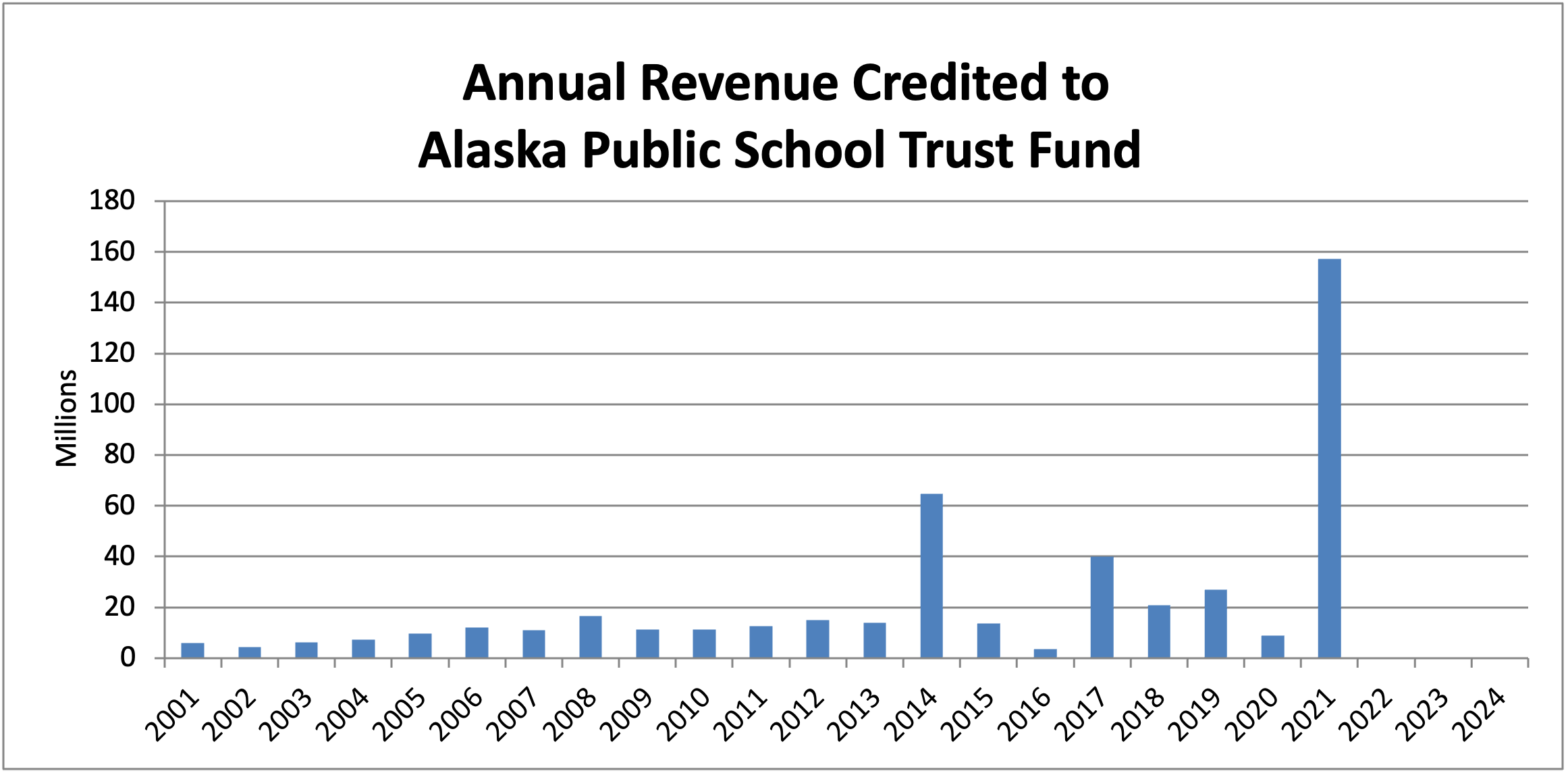
The Public School Trust Fund is then invested by the Commissioner of Revenue with the approval of the Public School Fund Advisory Board composed of the Commissioner of Education, three members elected by the Board of Education from among its members, and the Commissioner of Revenue.
The Public School Trust is invested by the Commissioner of Revenue Adam Crum located at 333 Willoughby Avenue, Suite 11, in Juneau. His office can be reached at (907) 465-2300. The value of the Alaska Public School Trust is $833,816,028.
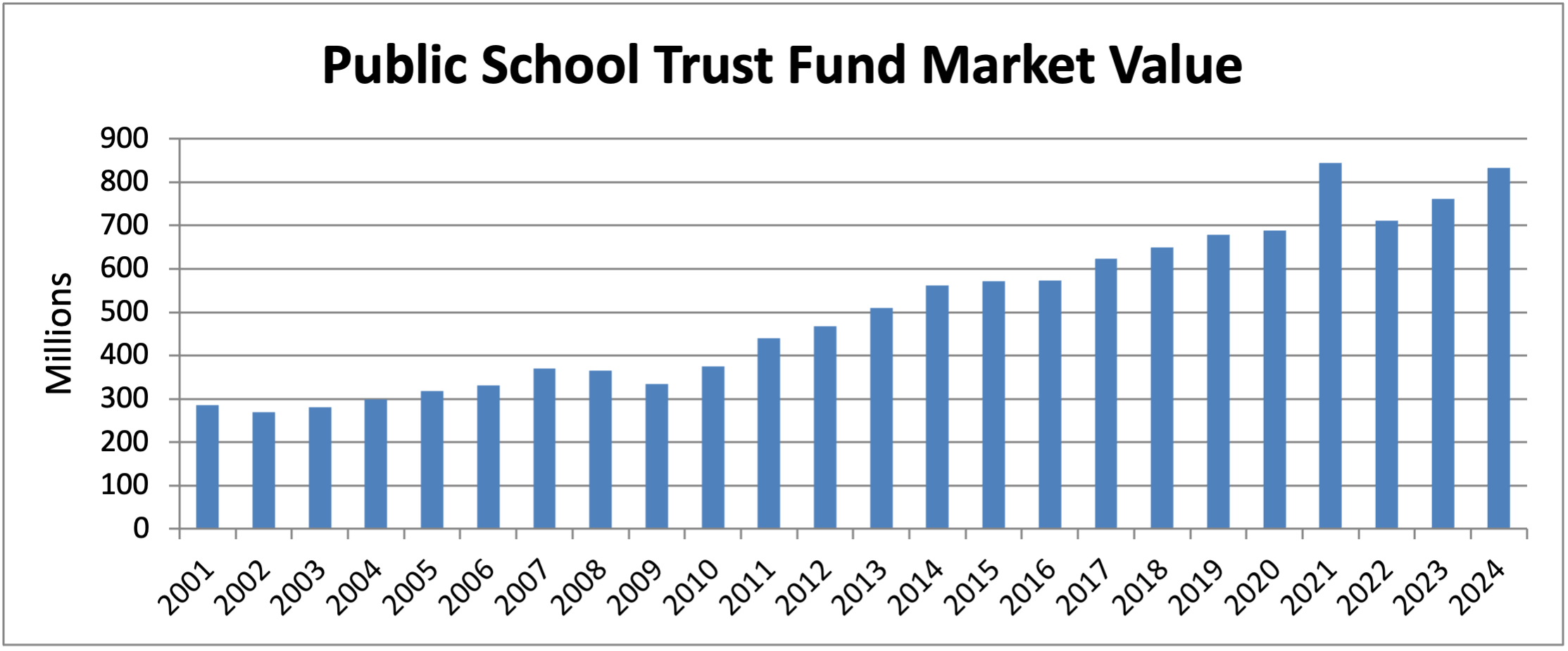
The return is 13.19%, obtained over the internet and probably includes fees. The Commissioner of Revenue failed to respond to requests for market value, so the value was researched via the internet and confirmed by the Department of Natural Resources. By law the capital gains stay in the principal of the Public School Trust Fund to grow the fund to continue to have an impact on funding schools for Alaska’s school children.
Most important is the revenue to schools. Annually since 2018, the legislature can appropriate up to 5% of a 5-year running monthly average to schools.
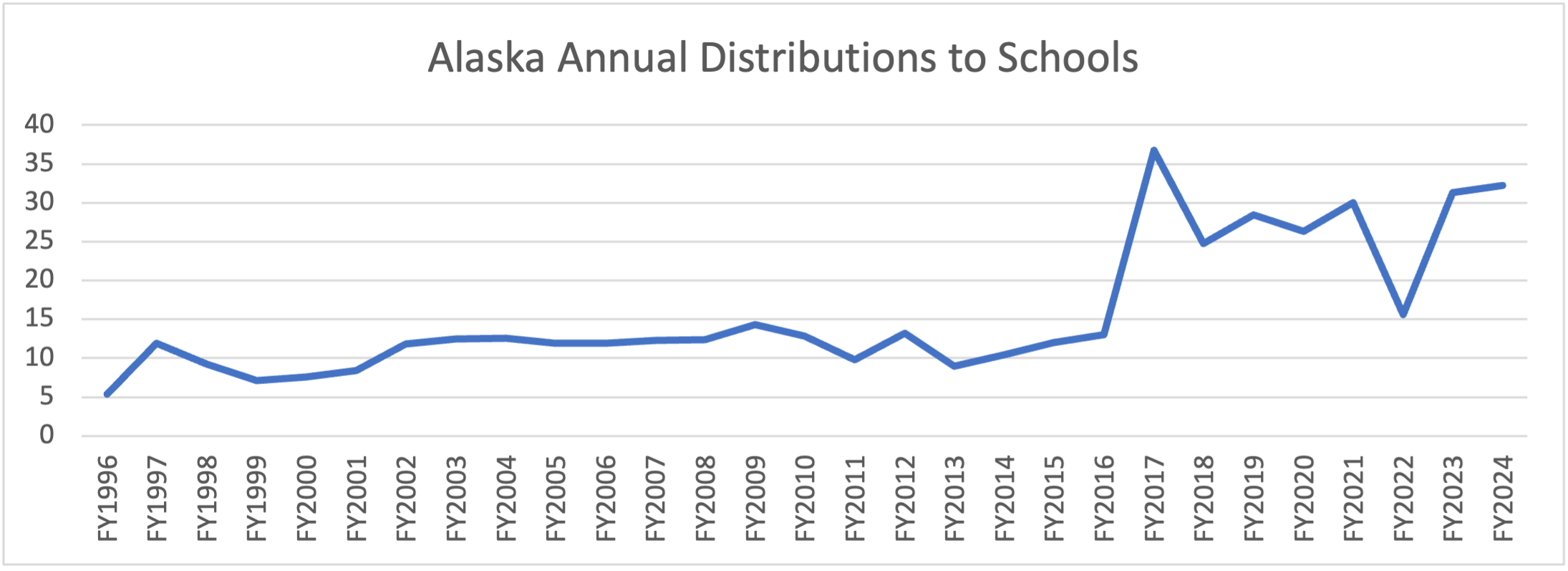
In FY 2024 the distribution to schools was $32,240,700 million. That is a significant payment given that the state indicates there are 131,264 public school students. The per pupil distribution was over $246 per student in FY 2024. Education leaders in Alaska should work to see that distributions go directly to schools, so each school can design an educational plan that meets that school’s unique needs.
1 See legal notes on the Alaska Enabling Act, Proclamation No. 3269.
FY2024 at a Glance
| Acres granted at statehood | 104,000 transferred (1959; 1915 Enabling Act would have granted ~20M had territory been surveyed) |
|---|---|
| Surface acres currently held | School lands not tracked separately (1978 re-designation; Kasayulie breach finding 1999) |
| Mineral acres currently held | Awaiting consolidated public disclosure |
| FY2024 gross revenue | Awaiting consolidated public disclosure |
| FY2024 PSF market value | $833,816,028 |
| FY2024 distribution to schools | $32,240,700 ($246/student across 131,264 students) |
| Reported return | 13.19% (likely includes fees; source: state website) |
Data: ASTL FY2024 state report. Some figures are pending or carried from prior years where indicated.