
School Trust Lands
Arizona
Arizona's school-trust story is, on the federal side, the strongest in the country. Nowhere else does the granting Act use harder language. Section 28 of the 1910 New Mexico-Arizona Enabling Act calls the lands "in trust," labels non-conforming dispositions a "breach of trust," voids them automatically — any provision of state law to the contrary notwithstanding — and authorizes the United States Attorney General to sue the state to enforce the trust. Express trust, breach-of-trust label, automatic nullity, federal enforcement. These four features are the architectural high-water mark of school-grant federalism.
Arizona and New Mexico share that statute word for word. They diverged anyway. New Mexico's Commissioner of Public Lands is elected statewide and answers to the voters; Arizona's State Land Commissioner is appointed by the Governor and answers to the appointing executive. A century later, New Mexico's permanent fund is near $30 billion. Arizona's is closer to $9 billion. Same federal floor. Same admission date. Same quadrupled grant. Different state architecture, different outcomes.
The U.S. Supreme Court has enforced the federal language when it has been invoked — Lassen in 1967, the highway-easements case, recovered millions for the trust. State courts have built on top of it in Gladden Farms, Kadish, and Rumery. The unresolved fiduciary question on Arizona's docket now concerns groundwater consumed by agricultural lessees, including the Saudi-owned Fondomonte alfalfa operation: section 28 makes the natural products of trust land subject to the same trust as the land, and it requires true-value compensation. Whether the failure to price that water is a continuing breach is the question of the decade.
(As of June 30, 2024)
On May 20, 1785, the Continental Congress provided land to support schools as each new state joined the union. “There shall be reserved the lot No.16, of every township, for the maintenance of public schools within the said township.” The federal school-land grant ultimately reached a national scale, and school-trust lands still span tens of millions of acres across the public-land states. Public accounting gathered by ASTL documents more than $100 billion in school-trust assets and more than $1 billion in annual distributions in the most recently reconciled national accounting; current fifty-state figures are being rebuilt state by state. However, few educators or members of the public know about school trust lands. Advocates for School Trust Lands is sharing this grand history of America’s founding vision for schools, hoping that over time Americans will know of school trust lands and their support for public schools.
On February 14, 1912, Arizona joined the union, and Congress granted 10.9 million acres to Arizona, including four sections per township for the support of public schools. Schools received 9.49 million acres and now hold 8,024,118 surface acres and 937,212 mineral acres. About a half million acres are caught within federal designations, meaning they are not generating revenue for schools as Congress required. [1] All school trust lands are managed under the direction of Robyn Sahid, the State Land Commissioner, who is appointed by the governor. The Arizona Land Department is located at 1110 W Washington in Phoenix. The phone is (602) 542-4631. These lands are held in a multi-generational perpetual trust for the benefit of the public schools (https://land.az.gov).
During Fiscal Year 2024, the school trust lands generated $315 million in gross revenue and $248 million was invested in the school fund to continue to support Arizona’s public schools. The largest revenue sources are land sales and royalties, commercial lease payments, and interest on land sales. During FY 2024, there were 13 auctions which generated $242 million. Wow! Two long term solar leases were issued; 7,200 acres were treated for fire suppression; zoning banks were initiated to target mixed use communities; and $1.5 million was invested in commercial due diligence projects to attract global corporations
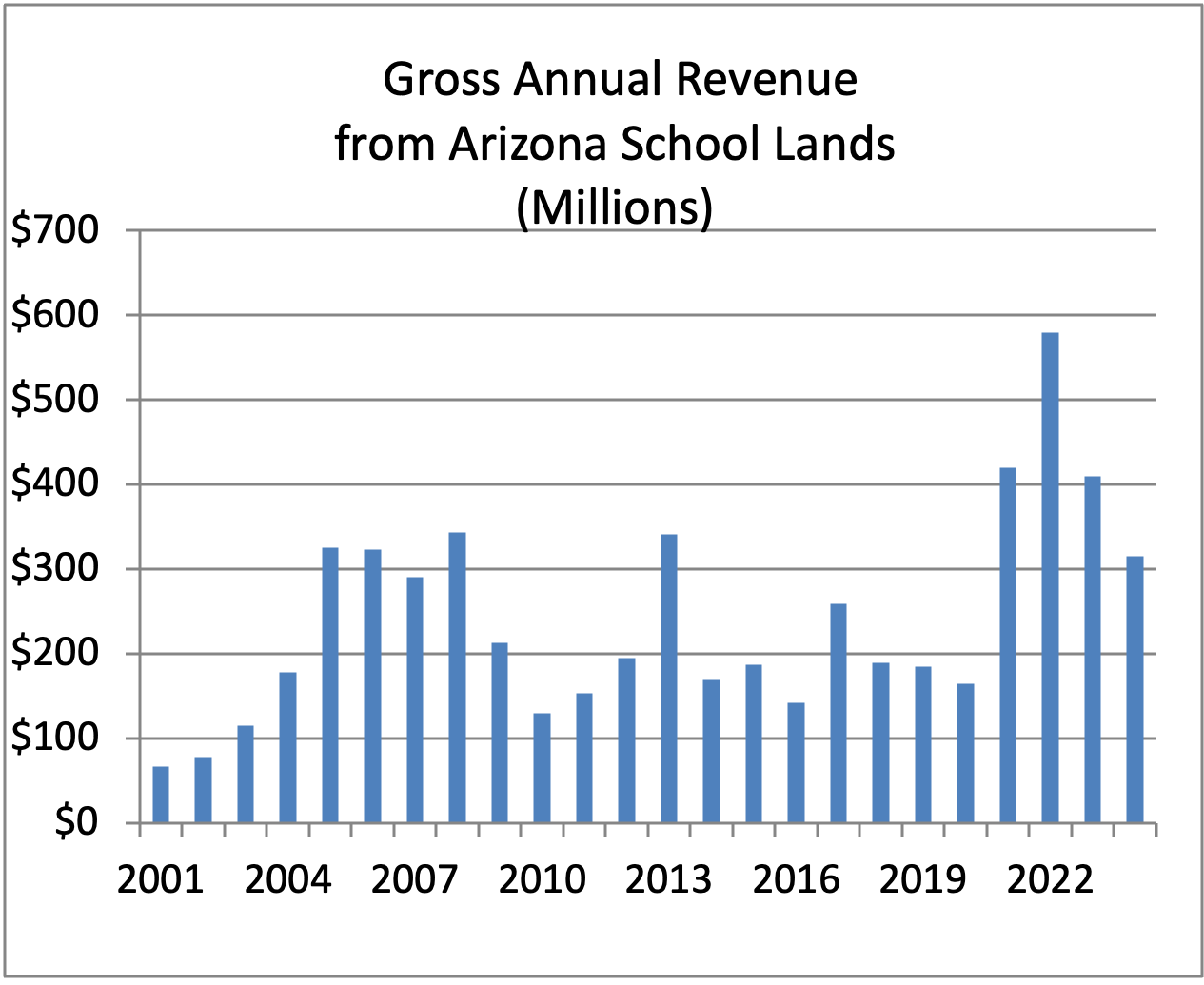
During Fiscal Year 2024, the school trust lands generated $315 million in gross revenue and $248 million was invested in the school fund to continue to support Arizona’s public schools. The largest revenue sources are land sales and royalties, commercial lease payments, and interest on land sales. During FY 2024, there were 13 auctions which generated $242 million. Wow! Two long term solar leases were issued; 7,200 acres were treated for fire suppression; zoning banks were initiated to target mixed use communities; and $1.5 million was invested in commercial due diligence projects to attract global corporations.
Expendable revenue from renewable sources, like leases and royalties, are sent monthly by the State Land Department to the Department of Education. Those renewable sources are split between the Classroom Site Fund and the regular state aid to education.
Permanent fund revenue from land sales and non-renewable sources are invested by the elected State Treasurer, Kimberly Yee, in the Permanent Common School Fund. Monthly distributions are sent to the Department of Education to be distributed to individual school districts. Since September 2019, Arizona has had a 5-year lockout of the initial investments of the Permanent Common school Fund that will run FY2000 to FY 2024. Thereafter, the annual distribution will be 4% unless the legislature and voters decide otherwise. Prior to this, Arizona was distributing the highest percentage of its school fund annually, meaning current school children were robbing future generations of school children. Due to Prop 123, Arizona was eating its seed corn. Legal challenges ensued and were lost by the state.
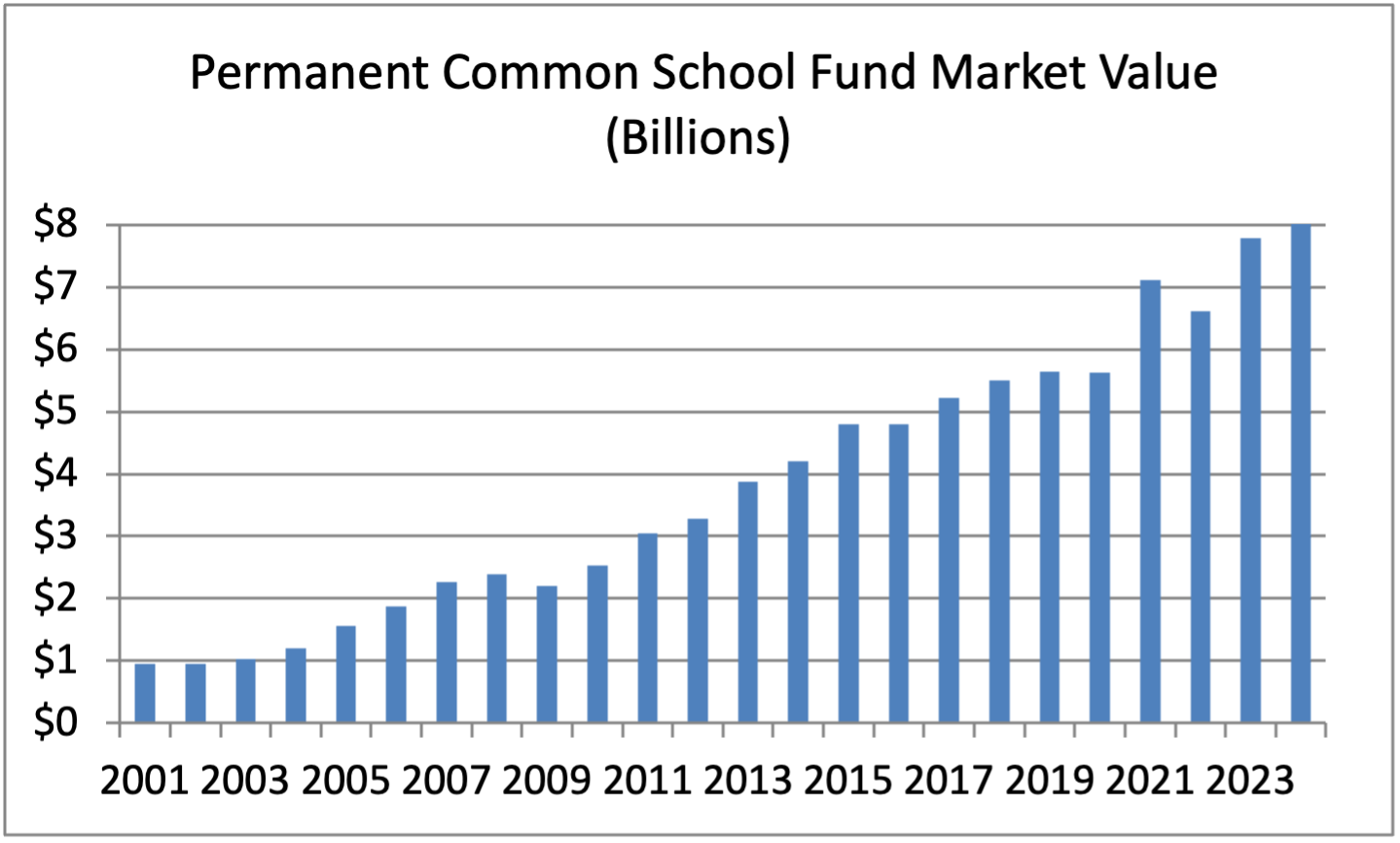
Profitable management of the school trust lands with prudent investment should lead to rapid growth in the Permanent Common School Fund. The Permanent Land Endowment Trust Fund includes the School Trust plus trusts for 3 universities, schools for the deaf and blind, state buildings, the state hospital, Pioneers’ Home, and juvenile and adult corrections. Collectively these funds are managed by the Arizona State Treasurer. Tim White is the Director of Endowments, and his office is located at 1700 W. Washington Street, Suite 102 in Phoenix, and available at (601) 542-7836. The funds are invested with 60% in equity indexing and 40% in active fixed income. Over the last 10 years the annualized total return is 8.24%. The market value of the Permanent Common School Fund was $6.62 billion as of June 30, 2022. The five-year time weighted return net of fees is not available until 5 years after the inception date of September 2019.
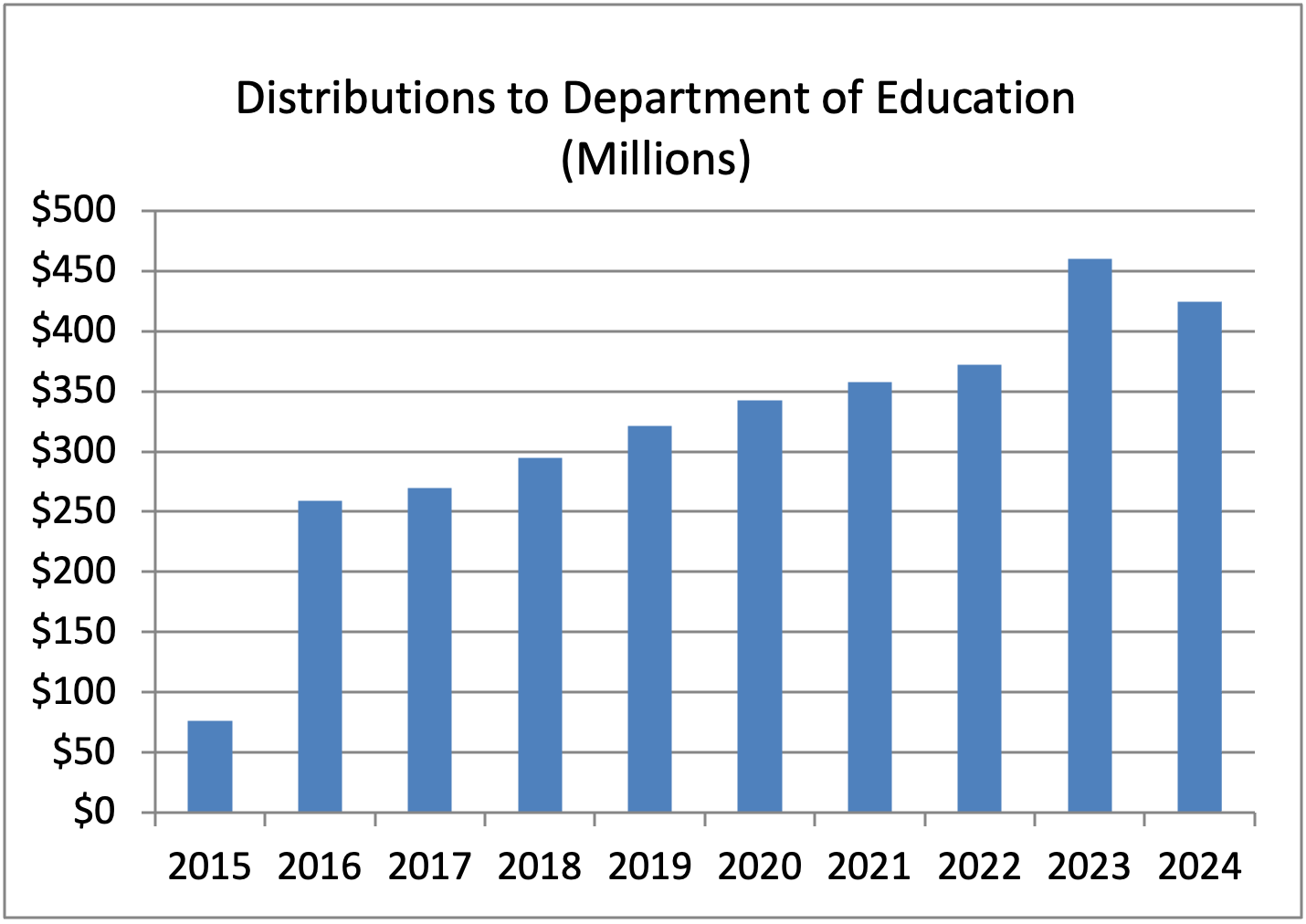
The Arizona School Trust has sent significant dollars to the Department of Education annually, even though the Enabling Act grant specifically stated the grant of four sections per township was to schools. Other western states comply with their enabling act and send the distribution directly to each district for distribution to their schools or directly to each school.
[1] There are 542,961 acres of school trust lands in federal designations in Arizona like National Monuments, National Parks, etc.
FY2024 at a Glance
| Acres granted at statehood | 9.49 million to schools (Feb 14, 1912; four sections per township) |
|---|---|
| Surface acres currently held | 8,024,118 |
| Mineral acres currently held | 937,212 |
| FY2024 gross revenue | $315 million ($248M invested in the fund) |
| PSF market value | $6.62 billion (as of Jun 30, 2022; FY2024 data pending) |
| FY2024 distribution to schools | Awaiting consolidated public disclosure (4% distribution post-lockout) |
| 5-year time-weighted return | Not available until 5 years after Sep 2019 inception (10-year annualized total return 8.24%) |
Data: ASTL FY2024 state report. Some figures are pending or carried from prior years where indicated.