
School Trust Lands
California
California pivots the cohort. From Ohio in 1803 through Wisconsin in 1848, every public-land state had received one school section per township. The 1853 California Act doubled the grant — sections 16 and 36 — and that doubling became the template for every Western state admitted until 1894. California is the original 2-section state.
The doubling did not save the trust. California received roughly 5.5 million acres for its schools and retains less than ten percent of that today. The losses were not drift. The legislature fixed the price at $1.25 an acre and held it there for decades while market values rose by an order of magnitude. The warrant-and-location system let private purchasers — not the state — pick which acres to acquire, so the best parcels in the Sacramento Valley and along the coast went to well-connected buyers and the state's residual portfolio was weighted toward acres no speculator wanted. A federal "Act to Quiet Land Titles" in 1866 retroactively confirmed the irregular sales. The architecture other 2-section states ratified in their constitutions was, in California, never installed.
What remains of the trust today no longer benefits California schoolchildren. Net revenue from the school lands is deposited into the State Teachers' Retirement Fund, not the public schools named in the 1853 grant. The architecture didn't fail. It was never built.
FY 2024
On May 20, 1785, the Continental Congress provided land to support schools as each new state joined the union. “There shall be reserved the lot No.16, of every township, for the maintenance of public schools within the said township.” The federal school-land grant ultimately reached a national scale, and school-trust lands still span tens of millions of acres across the public-land states. Public accounting gathered by ASTL documents more than $100 billion in school-trust assets and more than $1 billion in annual distributions in the most recently reconciled national accounting; current fifty-state figures are being rebuilt state by state. However, few educators or members of the public know about school trust lands. Advocates for School Trust Lands is sharing this grand history of America’s founding vision for schools, hoping that over time Americans will know of school trust lands and their support for public schools.
Five and a half million acres of school lands were granted at statehood in 1850 by Congress to California to support California public schools. That was 6% of all the land in the new state of California. From that original grant, there remains today 458,843 acres of surface lands and about 790,000 acres of mineral rights. The school trust lands are part of a “sacred compact” or enabling act between the state and Congress requiring the state to act with undivided loyalty as it manages the school lands in trust to support public schools.
Annual revenue from these lands in FY 2024 was $8,256,633. By far the largest revenue source is geothermal steam with additional contributions from oil, gas, and other minerals. A much smaller contribution came from surface leases for wind, solar, and forestry on the school trust lands.
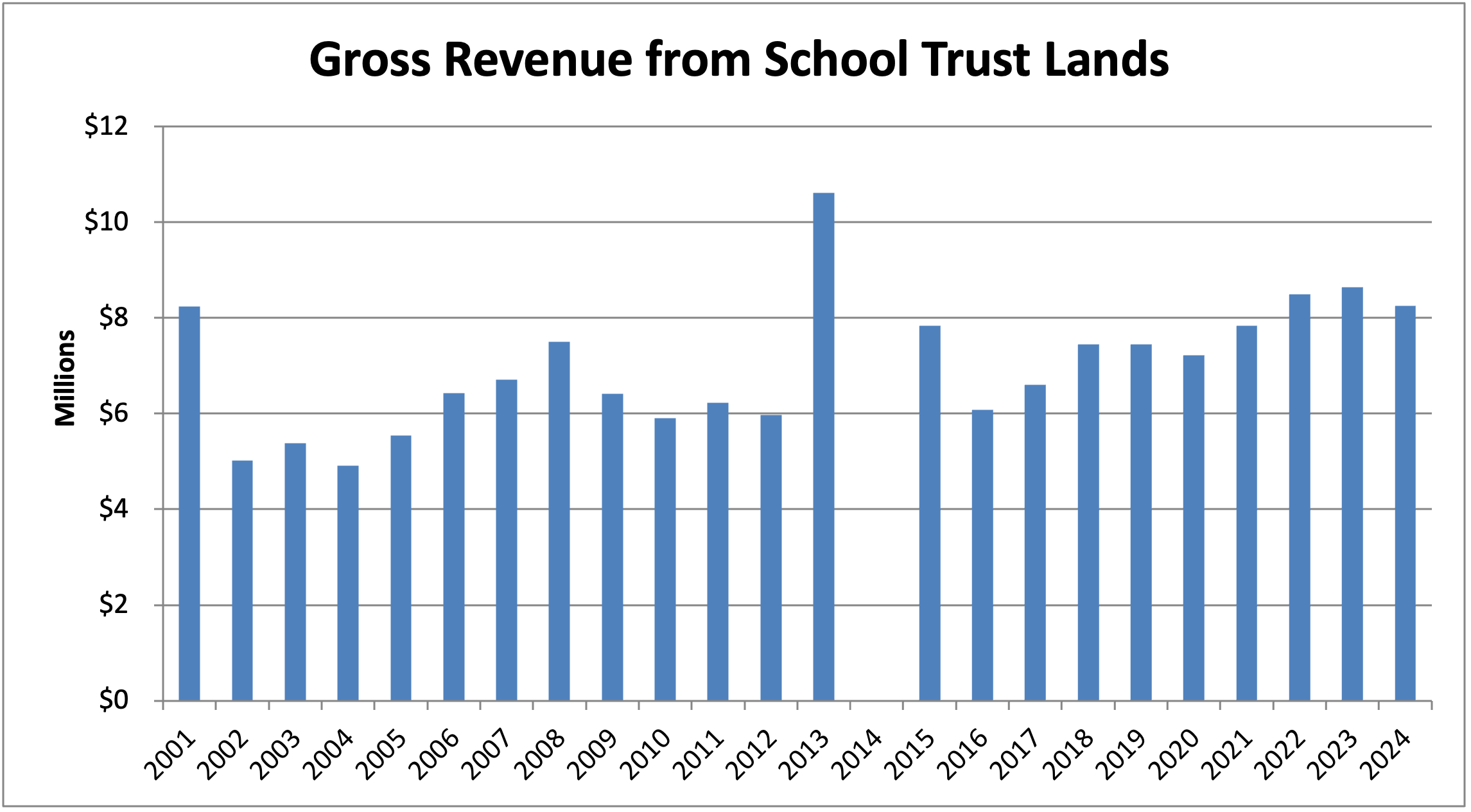
The lands are managed by two divisions of the California State Lands Commission. The Mineral Resources Management Division leases geothermal, mining, oil and gas lands, including collecting rental and production royalty payments. The Land Management Division oversees all surface land transactions including sales, exchanges and acquisitions, as well as agriculture, grazing, pipe and transmission lines, rights of way and surface leases. All expenses of the Land Commission and office are paid from the revenue that is generated. All net sale revenue is deposited in the State Treasury to the credit of the School Land Bank Fund. All other net revenue is regrettably deposited into the State Treasury to the credit of the State Teachers’ Retirement Fund. The revenue from the School Land Bank Fund benefits only retired teachers with no benefit to the public schools who are the named beneficiary of the lands in the California Enabling Act. To most readers of this report familiar with trust principles, the California legislature is in a position of breach of trust because the California state constitution and the state statutes do not comply with the provisions in the Enabling Act in which the lands were granted in trust for schools. To be a state, California voters passed the first state constitution accepting these 5.5 million acres held solely for the benefit of common schools.
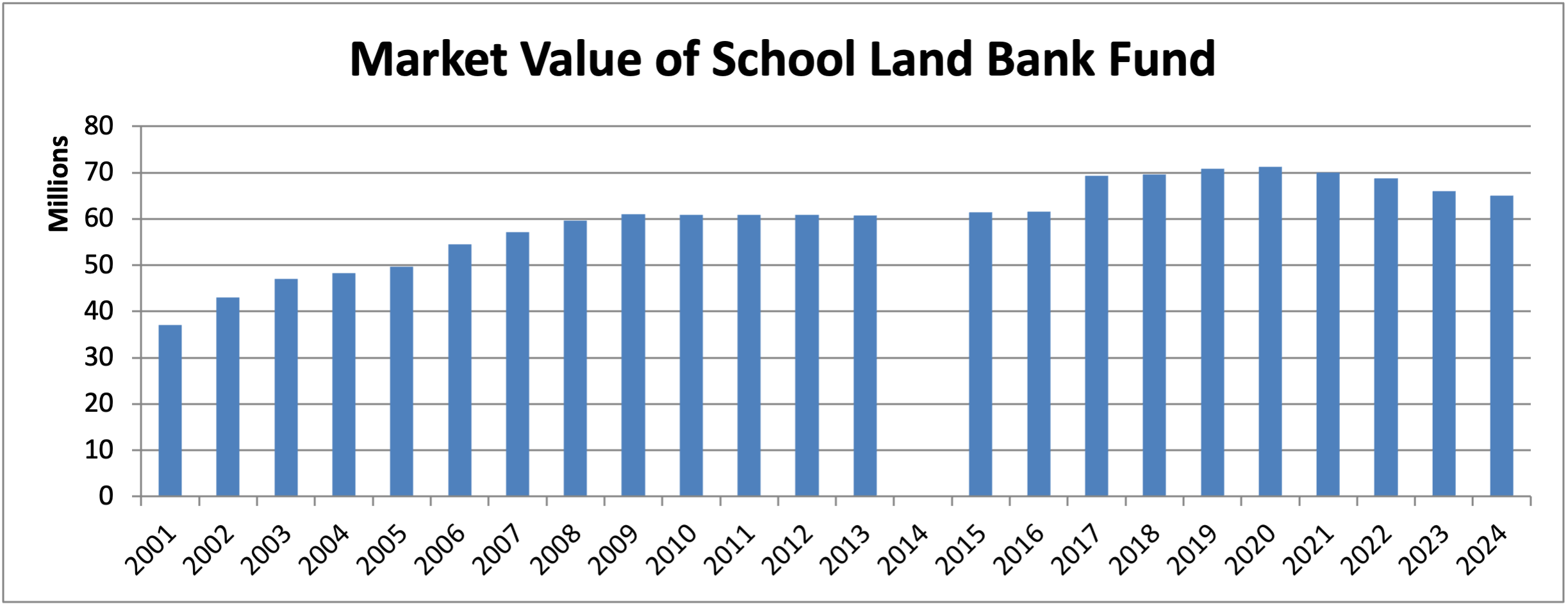
Net revenue from activities on the school trust lands is deposited in the School Land Bank Fund. [1] The market value of the fund is $64,965,889 as of June 30, 2024. The state borrowed $59 million of the $61 million invested in the School Land Bank Fund. The loan was repaid by June 30, 2016 with interest based on the rate generated by the Pooled Money Investment Account. Most of the states east of the Mississippi River lost their school endowment funds when borrowed funds were never repaid. California is applauded for its commitment to their school trust by repaying the loan. The fund appears to be returning very small amounts from their investments while investments in equities by other states have provided double digit returns to school funds.
The revenue from school lands and funds are used by schools differently in various states. Wisconsin funds school libraries, Washington and Colorado build schools in rural parts of the state, Arizona funds classroom needs, and Utah empowers school councils to implement academic programs in each school. Unfortunately, California school lands do not benefit California schools at all. The revenue benefits the State Teachers’ Retirement System—not schools at all.
[1] Loan was part of Budget Act of 2008, as amended by Chapter 2, Statutes of 2009 Third Extraordinary Session.
FY2024 at a Glance
| Acres granted at statehood | 5.5 million (1850; 6% of state) |
|---|---|
| Surface acres currently held | 458,843 |
| Mineral acres currently held | ~790,000 |
| FY2024 gross revenue | $8,256,633 (largest source: geothermal steam) |
| School Land Bank Fund market value (Jun 30, 2024) | $64,965,889 |
| FY2024 distribution to schools | $0 — net revenue is deposited to the State Teachers' Retirement Fund, not to schools |
| 5-year time-weighted return | Awaiting consolidated public disclosure |
Data: ASTL FY2024 state report. Some figures are pending or carried from prior years where indicated.