
School Trust Lands
Colorado
Colorado is the country's leading example of a state that worked the constitutional column and made it stick. The 1875 Enabling Act gave Colorado the same doubled grant — sections 16 and 36 — that Congress had been writing into every Western admission since California in 1853. The federal text was the older purposive form: no express "in trust" language, no restoration mechanism, no federal Attorney General enforcement. What turned that ordinary 1875 compact into one of the stronger trust architectures in the field was what the 1876 state constitution did on top of it. Article IX declared the Public School Fund "forever inviolate and intact," directed that only interest and income be spent, and added a clause unusual among public-land states: "The state shall supply all losses thereof that may in any manner occur." A constitutional make-whole guarantee, written at the founding.
The disposal-era losses were real. By the mid-1990s, Colorado had sold roughly 1.6 million acres of its original 4.6 million-acre surface grant. The recovery came on a single ballot. Amendment 16, ratified November 5, 1996, by just over 52,000 votes out of 1.36 million cast, restructured the State Board of Land Commissioners into a five-member constitutional body, replaced the maximum-dollar mandate with a stewardship-and-consistent-income standard, and created the 300,000-acre Stewardship Trust — a structurally distinct subset of school lands held to heightened conservation standards while still generating revenue for schools. The Tenth Circuit upheld the reform in Branson School District RE-82 v. Romer (1998).
Today the Public School Permanent Fund crossed $1.8 billion in fiscal year 2025, and the Building Excellent Schools Today program has channeled more than $1.4 billion to Colorado school districts for capital construction since 2008. Colorado is the case that recovery, by constitutional amendment with stewardship integrated into the fiduciary frame, is possible.
(as of June 30, 2024)
On May 20, 1785, the Continental Congress provided land to support schools as each new state joined the union. “There shall be reserved the lot No.16, of every township, for the maintenance of public schools within the said township.” The federal school-land grant ultimately reached a national scale, and school-trust lands still span tens of millions of acres across the public-land states. Public accounting gathered by ASTL documents more than $100 billion in school-trust assets and more than $1 billion in annual distributions in the most recently reconciled national accounting; current fifty-state figures are being rebuilt state by state. However, few educators or members of the public know about school trust lands. Advocates for School Trust Lands is sharing this grand history of America’s founding vision for schools, believing that over time Americans will advocate for school trust lands and their support for public schools.
On August 1, 1876, Congress granted school and institutional lands in trust in exchange for Colorado agreeing to never tax the federal lands within its borders. Sections 16 and 36 in each six mile square township were set aside to support schools. Schools received 3.7 million acres and now hold almost 3 million surface acres and almost 4 million mineral acres. [1]
These school trust lands were managed in FY2024 by Director Bill Ryan, under the direction of the 5-member Colorado State Land Board. The Colorado Land Board is non-partisan and includes 5 citizen volunteers in education, agriculture, local government, natural resources and an at-large position appointed by the governor. The board pledges their fiduciary duty on the website stating, “The State Land Board, as the trustee, has a legal and ethical obligation to act solely in the best interest of our beneficiaries.“ The main office is located at 1127 Sherman Street, Suite 300, Denver 80203 (website: slb.colorado.gov). There are 7 additional area offices. In FY2024, the management costs associated with running the Land Board were approximately 3% of revenues earned, among the lowest of all the school trust land states.
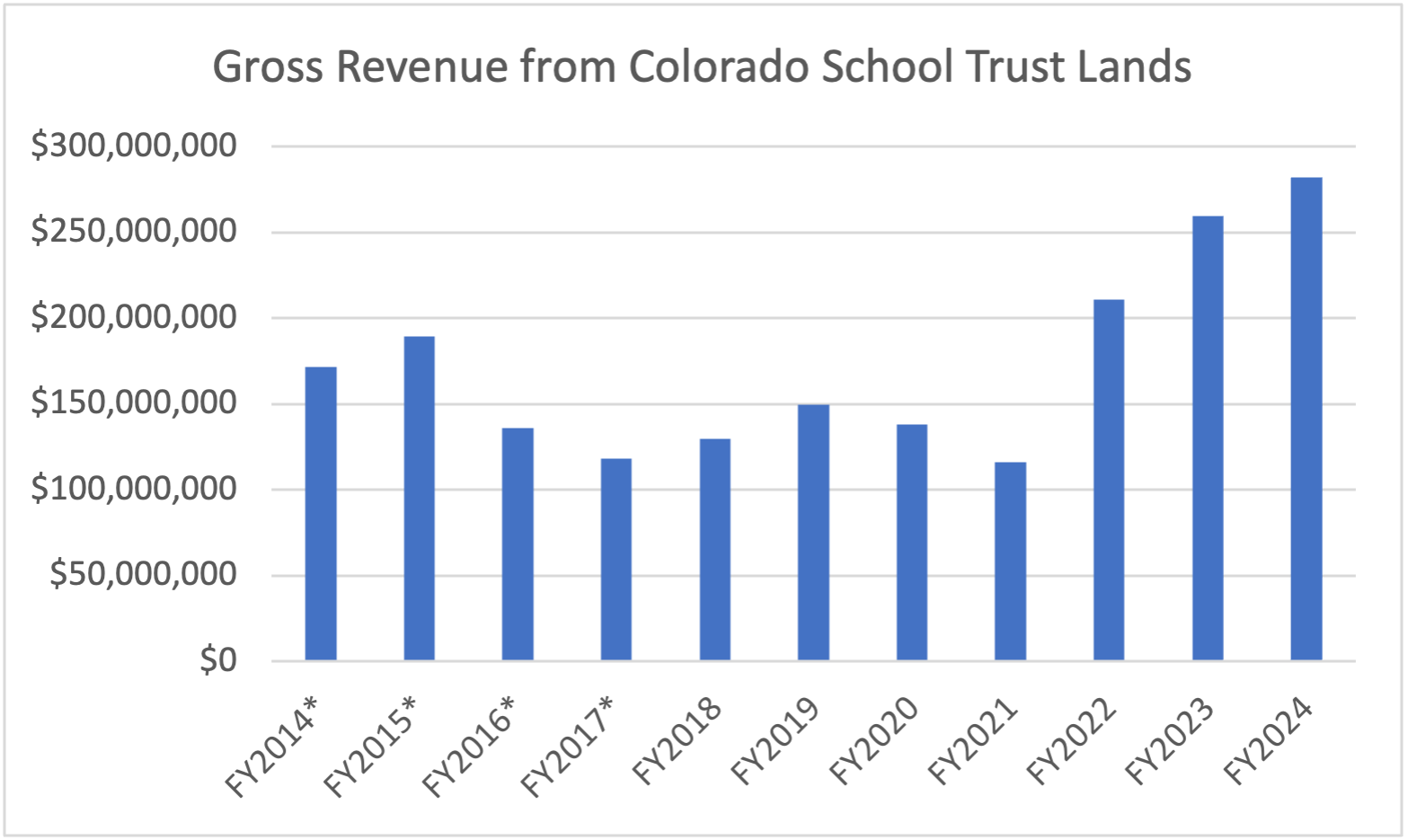
The largest revenue sources are oil, gas, and minerals, grazing and agriculture, and renewable energy commercial leases. In FY 2024, gross revenue on school lands topped all records at $282 million gross revenue from school trust lands. The FY2024 higher-than-anticipated revenue is largely a result of oil and gas leasing and royalty revenue. During this fiscal year an additional three miles of horizonal pipe were constructed for mineral extraction. Grazing and agriculture leases covered 96% of the land. The land office is making a strategic effort to diversify revenue opportunities with renewable leasing sources.
Colorado’s first wind turbine was on trust land. Renewable energy on trust lands generated 550 megawatts of power. In FY2024, thanks to the legislature, over 8,500 additional acres of school trust lands became state parks. Colorado Parks and Wildlife lease over 49,000 acres averaging $1.20 per acre. Such a low rate may make some wonder if the schools and children of Colorado are subsidizing parks for the state.
The Land Board believes that the continuing transition to a lower-carbon economy will lead to a decline in revenues in the long term. The practice of annually spending all oil and gas revenue on depreciable buildings instead of investing non-renewable revenue in the Colorado Public School Fund heightens the concern that this intergenerational trust will not be sustainable into the future with the current distribution policy. Thirty one schools got B.E.S.T. grants from oil and gas revenue while 1,836 K-12 schools went without. In most other states, the school trust distributions is shared by all schools.
“Grazing leases are a huge part of land stewardship for us. Grazing improves the land over time if you do it right.”
William Woolston,
Field Operations Supervisor
Colorado’s Constitution created the Stewardship Trust, a special management designation for approximately 10% of school trust lands. Even with this designation, the school lands are used as working land. The stewardship tools enable the land office to protect resources for the long-term benefit of beneficiaries while continuing to generate revenue in the short-term.
At statehood, Colorado Enabling act required the state to establish the Public School Permanent Fund.
“That the two sections of land in each township herein granted for the support of common schools shall be disposed of only at public sale and at a price not less than two dollars and fifty cents per acre, the proceeds to constitute a permanent school fund, the interest of which to be expended in the support of common schools.”
The Public School Trust Fund is managed by the elected State Treasurer and the Permanent Fund Investment Board (PFIB) which was created in 2016 “to ensure reasonable growth of the endowment.” Intergenerational trusts, like the Colorado School Trust, are to balance the benefits between the current generation and future generations. However, Colorado’s current statutory distribution policies
set by the legislature, advantage almost exclusively the current beneficiaries at the expense of future generations. Non-renewable resources can only be produced once. Current schools are robbing future schools. The 2024 legislative session took initial steps to enhance distribution through investments in equities which will expand earnings from the permanent Public School Fund.
This year, $96 million was reinvested into the Permanent Fund. However, last fiscal year nothing was deposited. Interest earnings in FY2022 were a record high of more than $33 million, peanuts compared to what it would have been had all proceeds been invested in the Public School Permanent Fund.
The school trust has been the largest funding source for the B.E.S.T. program since it was created in 2008. The B.E.S.T. program stands for Building Excellent Schools Today. The school trust has distributed more than $1 billion to B.E.S.T., which awards competitive capital construction grants to school districts to build new school buildings (30%), repair roofs (30%), or enhance existing school structures (40%). $144 million was distributed to B.E.S.T. in each of the last two years. It is important to recognize that money from a barrel of oil comes only once. Other states deposit all net revenue and grow the pot through investing; Colorado spends most of theirs on B.E.S.T. and the Department of Education which is not even a beneficiary. While Utah’s school fund has grown to $4 billion, Wyoming’s to $5 billion, North Dakota’s and Arizona’s each to $7 billion, New Mexico’s to $28 billion, and Texas’ to $57 billion,
Colorado has spent most of every year’s trust income on current school needs; however, fiduciary duty requires current trustees to balance the distributions between current and future beneficiaries. Current trustees are not measuring and balancing as required by standard best practices for trustees.
The Public School Trust Fund is managed by the elected State Treasurer and the Permanent Fund Investment Board (PFIB) which was created in 2016 “to ensure reasonable growth of the endowment.” Intergenerational trusts, like the Colorado School Trust, are to balance the benefits between the current generation and future generations. However, Colorado’s current statutory distribution policies set by the legislature advantage current beneficiaries at the expense of future generations. Colorado statute presently directs 50% of all revenues, plus 100% of Permanent Fund income, be distributed each year.
This limits the amount of reinvestment into the corpus to less than 40% of total income each year. The assertion is made on the PBIF website that they are committed to the long-term productivity and sound stewardship of the fund, but the legislature has enacted statutes that have directed most of the money to current students with little revenue invested in the fund to provide for future school children. Non-renewable resources can only be produced once, leaving none of their value for future generations of school children. Education groups need to lobby a change. Unlike most other western states, Colorado has deposited no revenue from the lands in the fund. Current schools are robbing the future for future schools.
This year, $96 million was reinvested into the Permanent Fund. However, last fiscal year nothing was deposited. As of March 31, 2023, the Permanent Fund value is $1.33 billion. Interest earnings in FY2022 were a record high of more than $33 million, peanuts compared to what it would have been had all proceeds been invested in the Public School Permanent Fund.
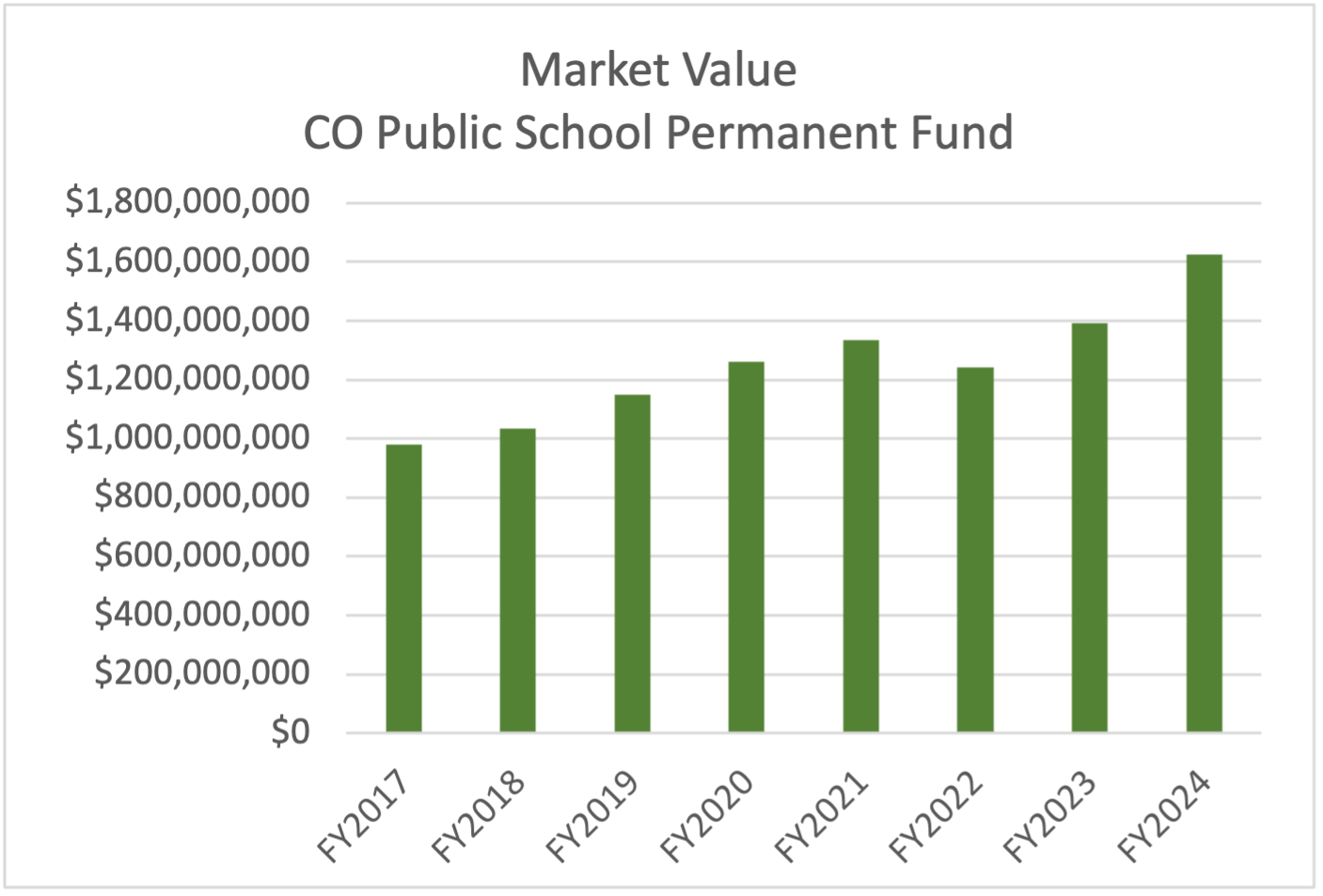
The Public School Permanent Fund is invested along with the other institutional trusts created at statehood for the University of Colorado, Colorado State University, Fort Lewis College, parks, corrections, and public buildings. The school fund constitutes 99% of the combined fund. Unlike other state sovereign wealth funds, Colorado’s Permanent Fund Investment Board does not publish the 5-year time weighted return, less fees, like other endowments.
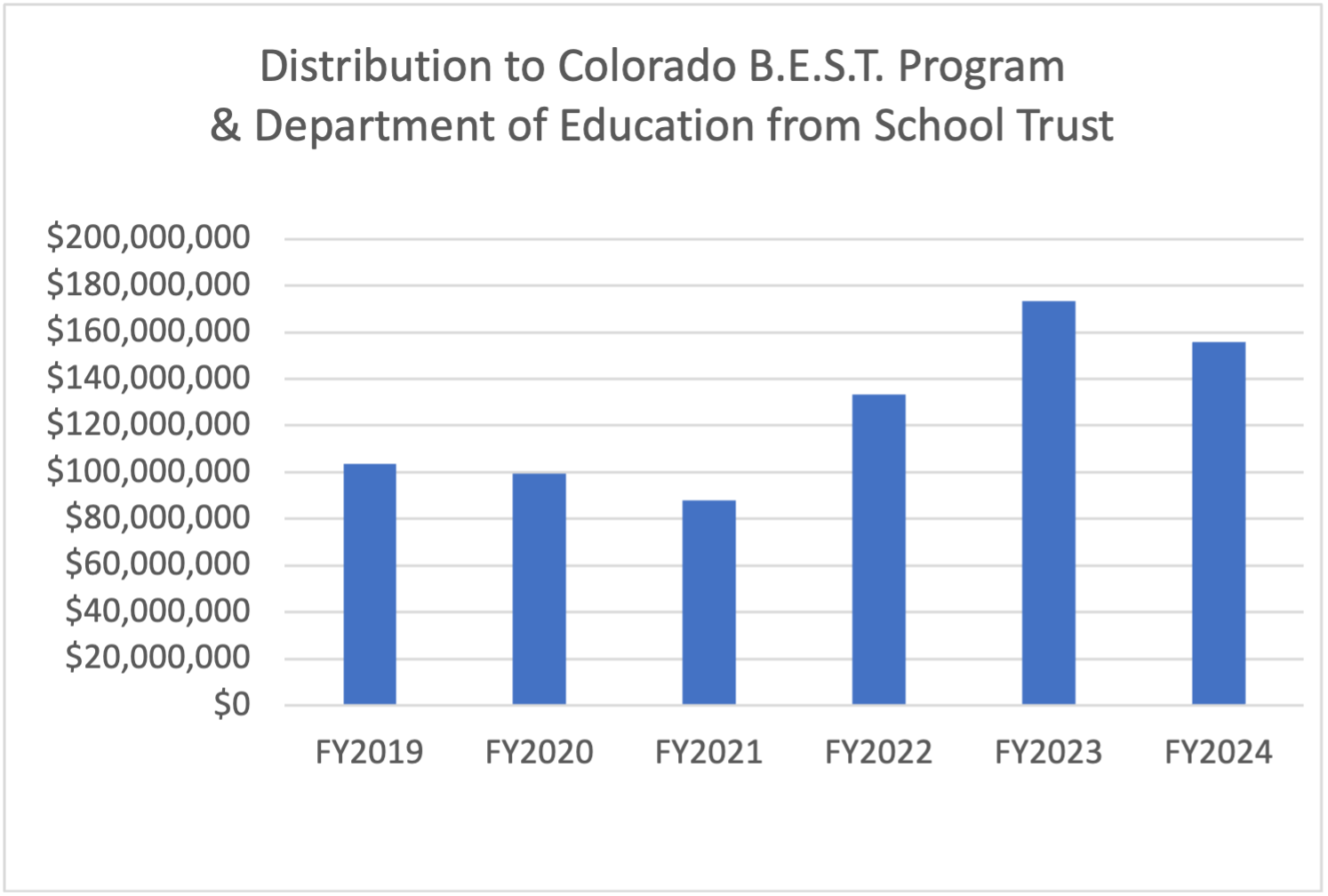
Other states with similar enabling act language invest all the annual net revenue from school lands to the permanent school fund and generally experience ever-rising distributions to their schools while balancing the inter-generational aspects of their trust. Tragically, Colorado is eating its seed corn.
[1] For data, go to slb.colorado.gov under About Us, then under Beneficiaries
FY2024 at a Glance
| Acres granted at statehood | 3.7 million (Aug 1, 1876; Sections 16 & 36) |
|---|---|
| Surface acres currently held | ~3 million |
| Mineral acres currently held | ~4 million |
| FY2024 gross revenue | $282 million (record; oil & gas leading) |
| Permanent Fund market value | $1.33 billion (Mar 31, 2023; FY2024 figure data pending) |
| FY2024 distribution | $144 million to B.E.S.T. (rural school construction); 31 of 1,867 schools received funds |
| 5-year time-weighted return (net of fees) | Not published by Permanent Fund Investment Board |
Data: ASTL FY2024 state report. Some figures are pending or carried from prior years where indicated.