
School Trust Lands
Minnesota
Minnesota is the state from which the doubled grant entered the eastern half of the country. California received sections 16 and 36 in 1853; Minnesota in 1857 was the first to carry that template east of the Mississippi, and Oregon two years later copied Minnesota's language almost verbatim. The lineage matters: the school-trust architecture that governs most of the trust-lands West was written first for Minnesota's pine country.
What followed in Minnesota is the canonical case study of post-Civil-War land-office fraud. The lumber companies that wanted Minnesota's pine did not buy it. They took it, by lifting names out of St. Paul and Chicago city directories, filing fictitious homestead claims at $25 a bribe per claim, and clear-cutting school sections on paper held by men who never existed. By the time a 1904 state investigation broke the pattern open, Minnesota had already lost more than two-thirds of its original eight-million-acre grant — most of the valuable timber gone, mostly swamp left behind. The thefts were designed, not accidental.
Minnesota's modern fund corpus — over two billion dollars, anchored by Mesabi Range iron-ore royalties State Auditor William Braden deliberately secured for the trust in 1889 — is hard-won. It is what an organized fiduciary office, finally, can build on top of what was not stolen.
(as of June 30, 2024)
On May 20, 1785, the Continental Congress provided land to support schools as each new state joined the union. “There shall be reserved the lot No.16, of every township, for the maintenance of public schools within the said township.” The federal school-land grant ultimately reached a national scale, and school-trust lands still span tens of millions of acres across the public-land states. Public accounting gathered by ASTL documents more than $100 billion in school-trust assets and more than $1 billion in annual distributions in the most recently reconciled national accounting; current fifty-state figures are being rebuilt state by state. However, few educators or members of the public know about school trust lands. Advocates for School Trust Lands is sharing this grand history of America’s founding vision for schools, hoping that over time Americans will know of school trust lands and their support for public schools.
On May 11, 1858, Minnesota joined the union, and Congress granted two sections per township “for the use of schools.” [1] Schools received 2,969,991 acres and now hold 2.5 million surface acres and 3.5 million severed mineral acres. School trust lands are managed by the Department of Natural Resources to ensure prudent and profitable management of the school lands with the Office of School Trust Lands (OSTL), established in 2012, providing advice on strategic management activities.
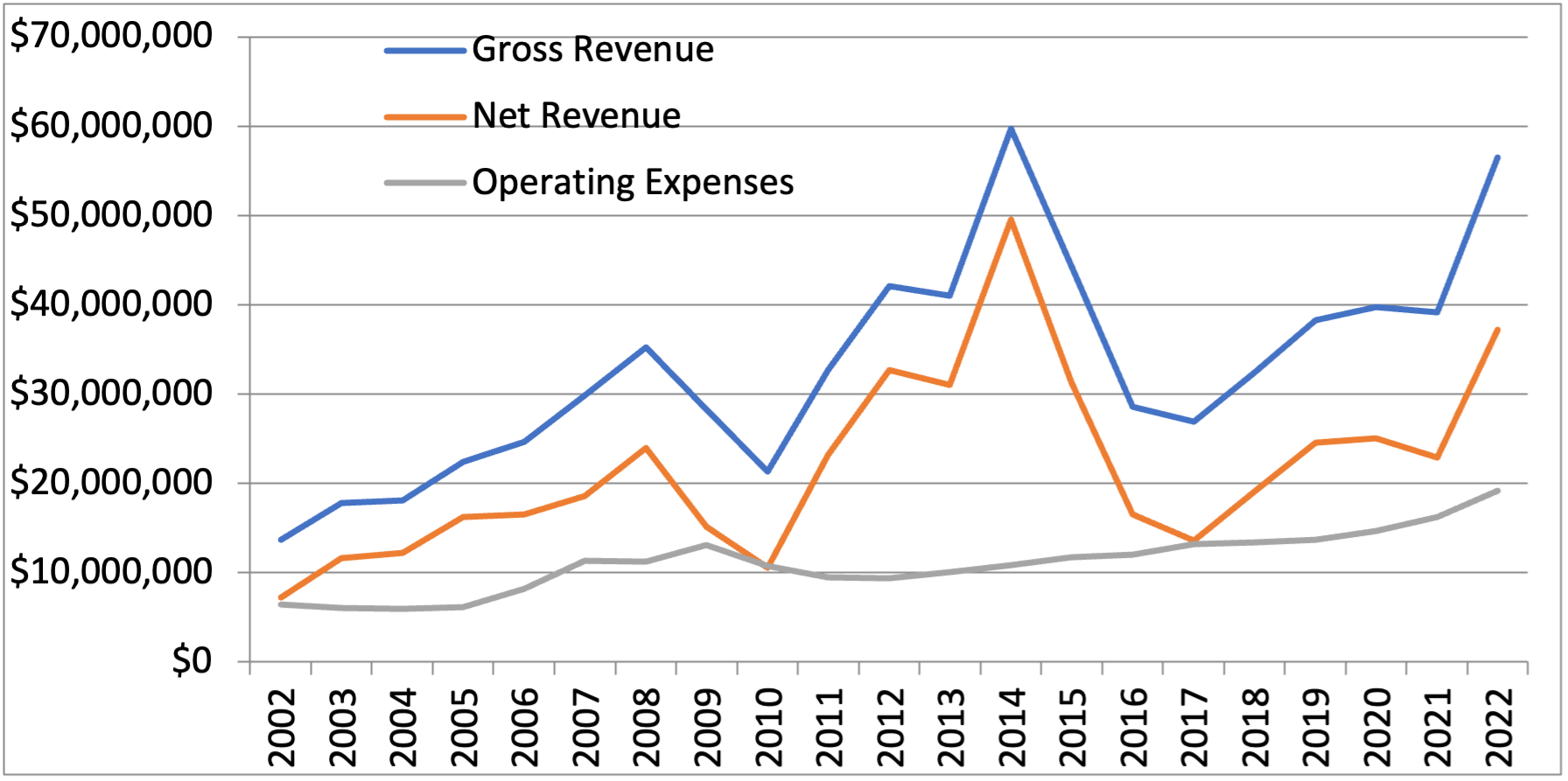
The Director of OSTL is Aaron VandeLinde. The office is located at 500 Lafayette Road, Saint Paul, Minnesota 55155. The office is responsible for advising the Governor, Executive Council, Legislative Permanent School Fund Commission, and the Department of Natural Resources on school trust management activities. OSTL also works with the twelve member Legislative Permanent School Commission that provides oversight and develops legislative initiatives to secure the maximum long-term revenue from school trust assets.
OASTL develops long-range strategic plans to ensure professional management of the school lands. They are bound by a fiduciary duty to ensure that both current and future beneficiaries receive maximum economic returns from school trust assets. As trustees, they have legal and ethical responsibilities to act solely in the best interest of Permanent School Fund beneficiaries.
Two years ago, the Department of Natural Resources, through whom all the fiscal accounting for school trust land revenue passes, reported gross school annual revenue of $56 million. Despite legislation requiring annual reporting , there appear to be no reports from the Department of Natural Resources on the revenue from millions of acres from FY2020 through FY2024. [2] The last biennial school trust land report dates to FY2019. I
Most unfortunately, the Minnesota legislature did not seat the legislative Permanent School Fund Commission. This failure existed because Senate Republicans, Senate Democrats, and House Republicans each failed to make the three appointments as required by law. [3] Only the House Democrats made their three appointments, so the Commission is not currently functioning. Without a functioning Commission there appears to be no authority empowered to force the Department of Natural Resources to comply with the duty to provide a proper accounting to the beneficiaries. Advocates for School Trust Lands remain gravely concerned with the absence of any reporting on annual gross revenue on 2.5 million surface acres and 3.5 million severed mineral acres for four consecutive fiscal years. Perhaps Minnesota should consider moving the management of school trust lands to the Office of School Trust Lands as the DNR mission is diametrically opposed to securing the maximum long-term revenue from school trust lands, as required by law. [4]
The Office of School Trust Lands and the Department of Natural Resources completed Phase 1 of the first ever Asset Management Plan in FY2022. However, most importantly there is no DNR data online to indicate either the cost to schools for Phase 1 or its impact on revenue. According to the FY2023 report, it is anticipated that Phase 2 will focus on the costs and performance of revenue production “to increase transparency.” As of May 26, 2025, it has been 11 months since FY2024 ended and there is no data on the school trust revenue on the Department of Natural Resources site. Without that data, OSTL cannot make its annual report to the beneficiaries, the school districts of the state. A failure to maintain proper and adequate records is an actionable breach of trust.
To see the accomplishments from last fiscal year go to OSTL Accomplishments Report 2022-23 (mn.gov). The largest revenue source is from iron mining which is non-renewable. Eighty percent of mineral revenue is invested in the Permanent School Fund. The other 20% goes to cover mineral management expenses by the Department of Natural Resources’ Division of Lands & Minerals[AV1.1]. Timber revenue, as the second largest revenue source, goes into the Forest Suspense Account, where annual costs are certified, and about one-third of revenue is then deposited in the Permanent School Fund.
Investments of the Permanent School Fund are made by the State Board of Investments, established in 1885 and managing over $100 billion in state assets including the Permanent School Fund. Before 1998, all investments were in fixed income assets like bonds. Since that time, the legislature has provided for investments more like those of large endowments with net realized capital gains being added to principal. In the case of net capital losses, the loss is offset by investment income from interest and dividends to repay the loss prior to any distributions to school districts.
Investment income from the Permanent School Fund is allocated to the Department of Education which distributes to school districts based on student population. Wise and prudent equity investment along with profitable iron and timber harvesting revenue from the trust lands has led to the Permanent School Fund almost doubling since FY2014. The market value of the Permanent School Fund as of June 30, 2024. is $2.1 billion. The five-year Time Weighted Return (TWR) net of fees is 7.7%. This high rate has been maintained with the 10-year at 7.4% and the 20-year at 7.2%. Over this 20-year period, the State Board of Investments has beat the benchmarks in each of the prior mentioned periods. Pretty impressive!
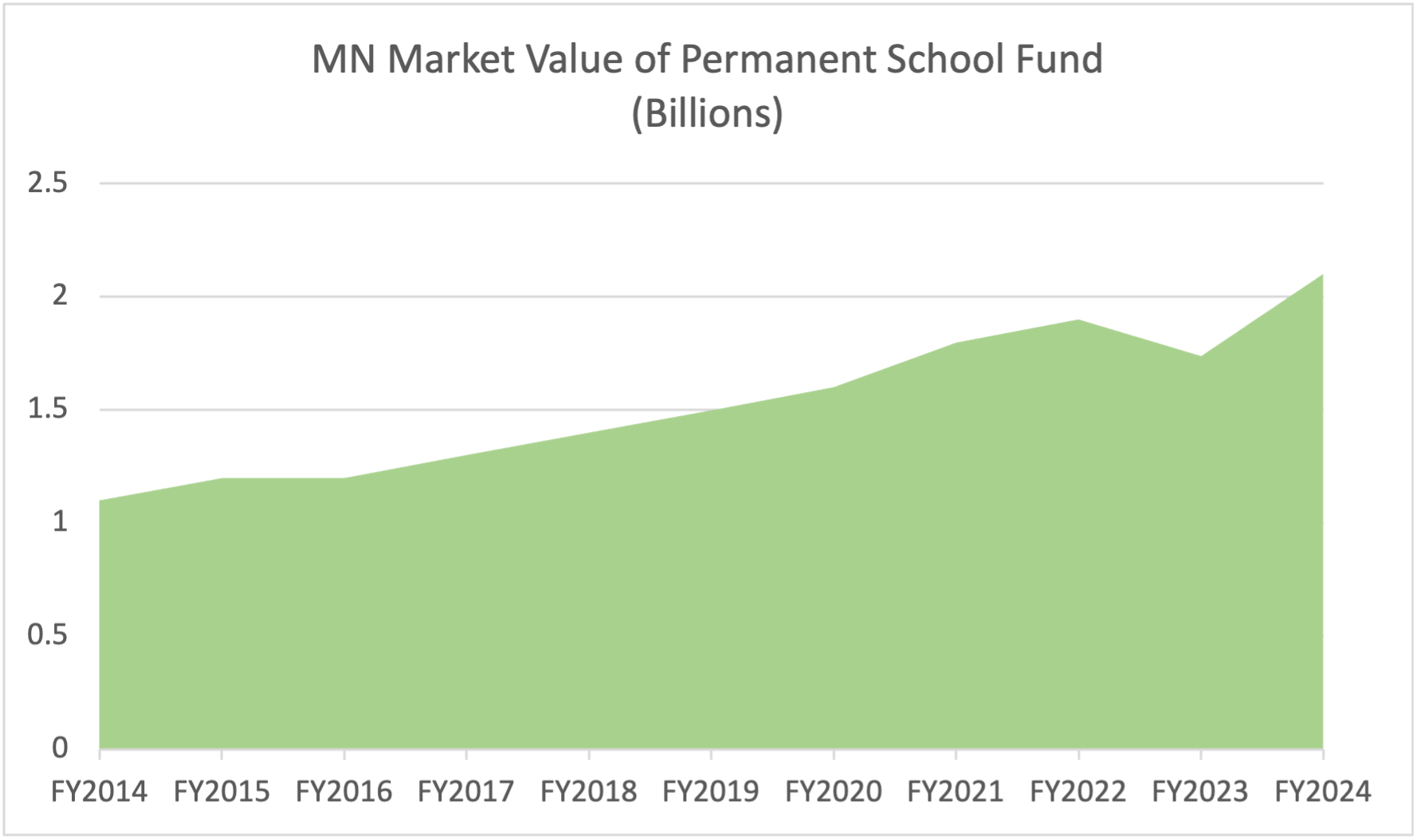
Every K-12 public school student in Minnesota is a trust fund baby. All 850,575 public school students in the state's 329 public school districts and 181 academies and charter schools are the recipients of the distributions from the Permanent School Fund.
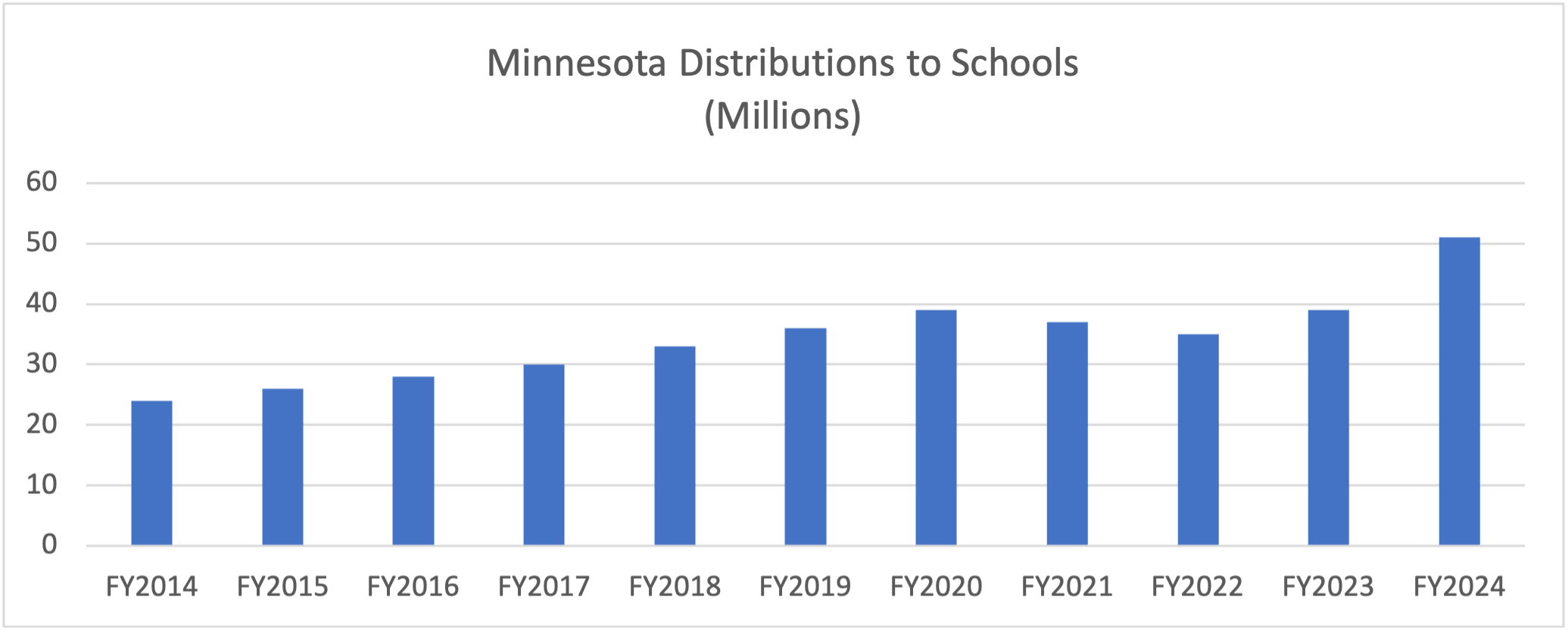
Every public school district and charter school in Minnesota annually receives school trust funding based on student enrollment. This is in addition to the general education aid that the state provides to all school districts. Distributions provide resources for educational supplies, designing and modeling school curricula, teacher salaries, extracurricular activities, maintaining quality facilities, and all that makes Minnesota's schools among the top-performing, rigorous schools in the country. The revenue generated from school trust lands is used exclusively for the benefit of Minnesota's schoolchildren without question, without exception, and in perpetuity.
[1] Minnesota Enabling Act
[2] 2024 Minnesota Statutes 84.027 Subdivision 18A, requires the following of the Commissioner of the Department of Natural Resources: “The commissioner shall biennially report to the Legislative Permanent Fund Committee and the legislature on the management of the school trust lands . . . “
[3] Minn. Stat. sec. 127A.30
[4]Minn. Stat. sec. 127A.31
FY2024 at a Glance
| Acres granted at statehood | 2,969,991 (May 11, 1858; two sections per township) |
|---|---|
| Surface acres currently held | 2.5 million |
| Mineral acres currently held | 3.5 million severed |
| FY2024 gross revenue | Not reported by DNR for FY2020–FY2024 (statutory breach of biennial reporting duty) |
| PSF market value (Jun 30, 2024) | $2.1 billion |
| FY2024 distribution to schools | Awaiting consolidated public disclosure (allocated by student population to 850,575 students) |
| 5-year time-weighted return (net of fees) | 7.7% |
Data: ASTL FY2024 state report. Some figures are pending or carried from prior years where indicated.