
School Trust Lands
North Dakota
North Dakota came into the union in the four-state class of 1889 — the Omnibus Enabling Act delivered statehood to North Dakota, South Dakota, Montana, and Washington on a single template. Each received sections 16 and 36 of every township in trust for common schools. The four states received the same instrument. They did not produce the same outcomes. North Dakota's record sits on the disciplined end of the comparison.
The state retained roughly 700,000 surface acres of its original 2.5-million-acre grant and built a Permanent Fund whose later decades benefited from a geological accident no nineteenth-century legislator could have priced — the Bakken oil formation underneath the state's school sections. What matters editorially is not the oil. It is that North Dakota's trustees were positioned to capture the revenue when the oil came up. Margaret Bird's summary is matter-of-fact: smart investment people; mineral royalties protected; fund corpus that runs into the billions. The trust framework worked here because the institution behind it was built to do its job rather than to redirect the proceeds. The contrast with peer states that received the same enabling-act language and ended up with hollowed-out funds is the point worth carrying forward: identical instruments produced different results because the trustees made different choices.
FY 2024
On May 20, 1785, the Continental Congress provided land to support schools as each new state joined the union. “There shall be reserved the lot No.16, of every township, for the maintenance of public schools within the said township.” The federal school-land grant ultimately reached a national scale, and school-trust lands still span tens of millions of acres across the public-land states. Public accounting gathered by ASTL documents more than $100 billion in school-trust assets and more than $1 billion in annual distributions in the most recently reconciled national accounting; current fifty-state figures are being rebuilt state by state. However, few educators or members of the public know about school trust lands. Advocates for School Trust Lands is sharing this grand history of America’s founding vision for schools, hoping that over time Americans will know of school trust lands and their support for public schools.

At statehood, 2.5 million acres of school lands were granted in 1889 by Congress to North Dakota to support public schools. The school trust lands are part of a “sacred compact” or enabling act between North Dakota and Congress. The enabling act requires the state to act with undivided loyalty as it manages the lands in trust for public schools. North Dakota has 700,000 remaining surface acres and another 2.6 million mineral acres.
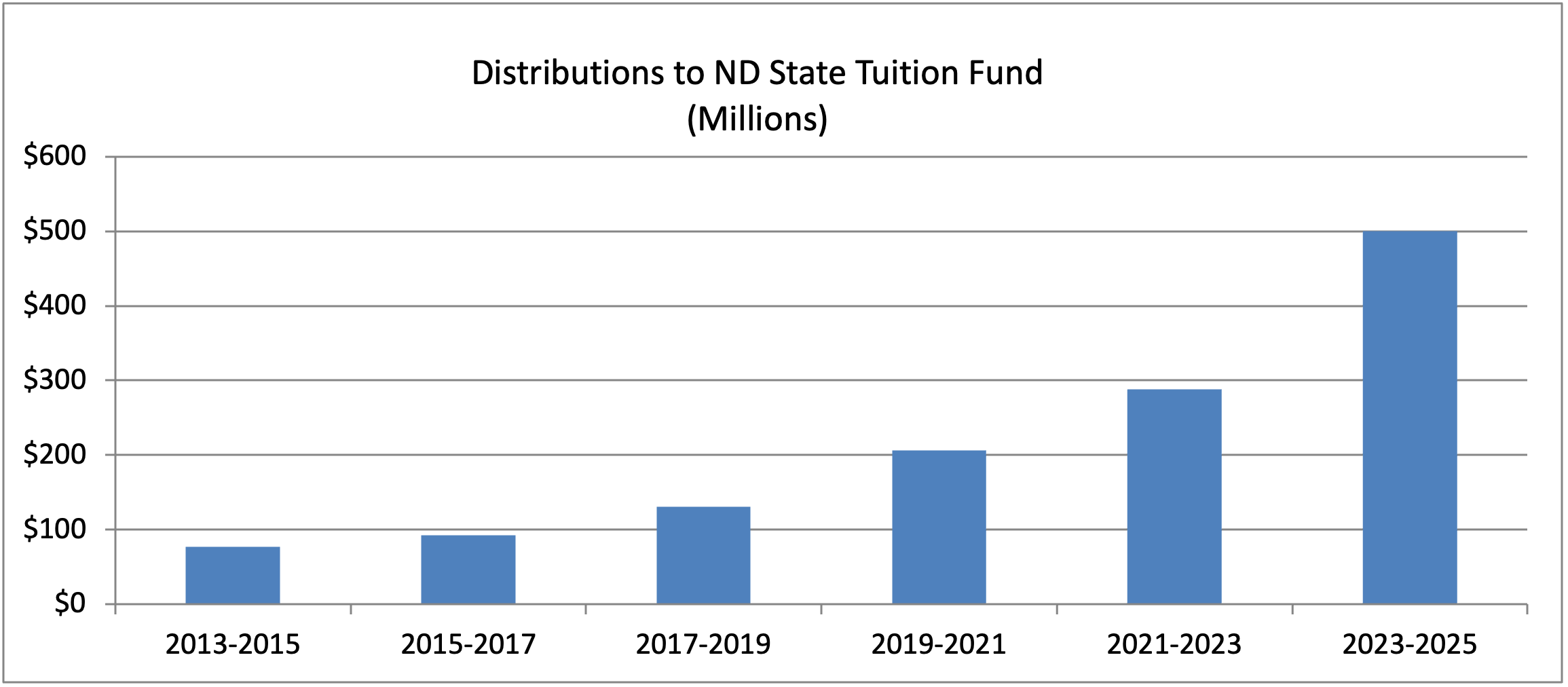
Investment income, oil and gas royalty payments, and the oil extraction tax dominate the revenue stream from the school lands. The Department of Trust Lands collects 1% per 30 days for all royalty payments based on the time value of money versus most states that charge a much lower interest rate. The agency also works with operators of low or non-producing wells to get the wells in production or let the lease expire. The agency has been an innovator in using Light Detection and Ranging technology, which can track the amount of product removed from surface mines using laser lights. This allows the agency to receive full payments for production on gravel pits and other surface mining. Their most significant accomplishment this year is the record K-12 distributions which have gone from $77 million in BIENNIUM 2009-2011 annually to $500 million in 16 years. PHENOMINAL! Only Wyoming distributes more per student than North Dakota.
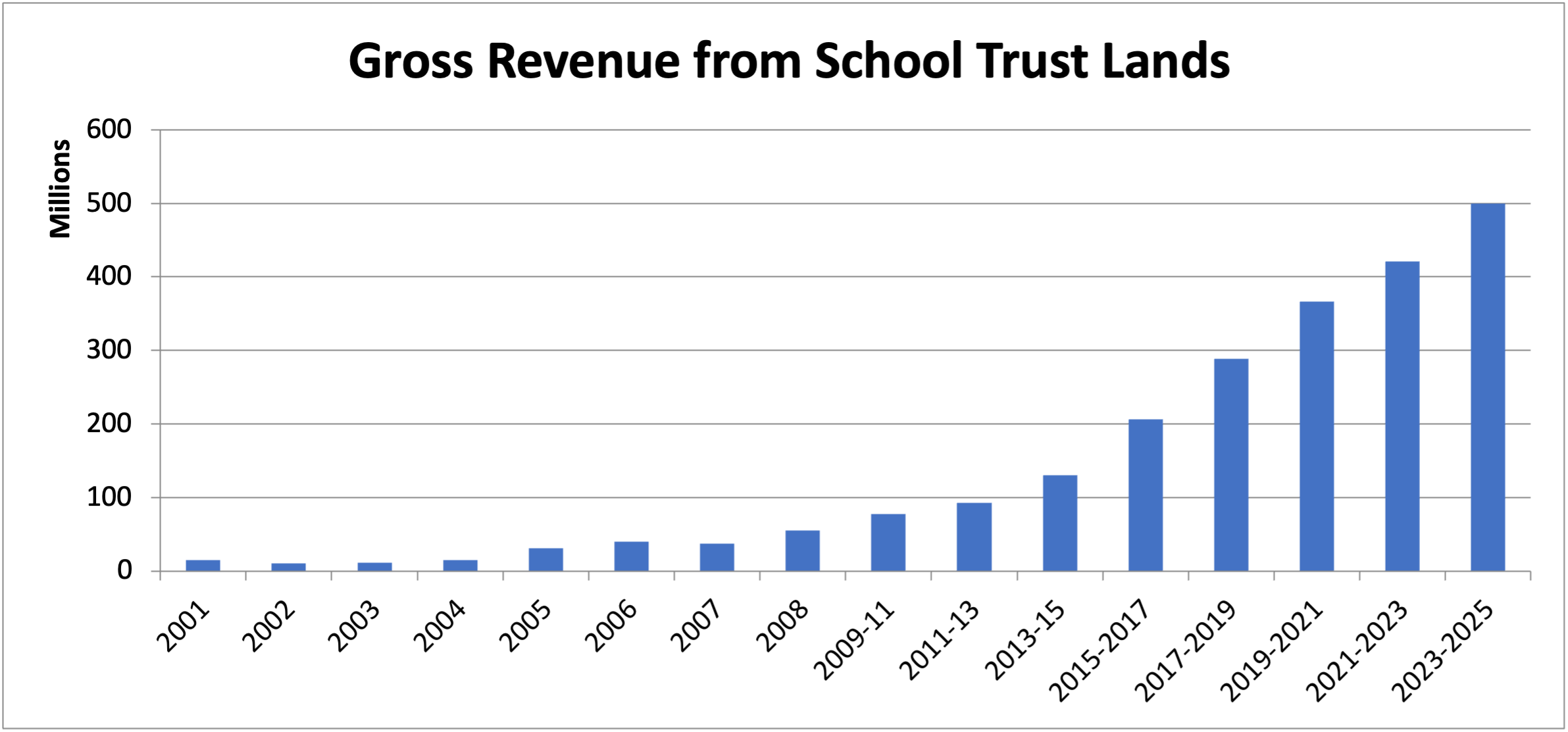
North Dakota deposits all revenue from the school trust lands into the Common Schools Trust Fund. In addition, North Dakota also deposited additional millions from the Tobacco Lawsuit Settlement, unclaimed property turned into the state, and the oil extraction tax. From these deposits is deducted the trust expenses. Net income is prudently invested, and schools receive annual distributions based on a five year average value of the Common Schools Trust Fund. States like North Dakota that invest all of their revenue in the Common School Trust Fund plus additional funds have, over time, more money to support schools, just as people who save have more money than those who spend all they make. When prudently invested, the Common Schools Trust Fund will generate greater revenue to schools.
The North Dakota Common School Trust Fund has had phenomenal growth over the last 39 years, growing from a market value of just under $240 million to now being within a hair’s breath of being $7 billion—a growth of 2900%. As of June 30, 2025, the market value of the fund stands at $6,997,804,865. The fund is prudently invested and generating a total weighted 5-year return on investment of 5.68%.
The Common School Trust Fund is constitutionally established and recognized as a trust by the United States Supreme Court. It is intended to be a forever charitable trust. The obligations to protect and grow this forever trust were accepted by the state as a condition of statehood. The state of North Dakota committed to acting with undivided loyalty to both the lands and resulting funds for the sole benefit of schools. The state’s commitment to the School Trust has reaped significant benefits to schools. It is anticipated that by next biennium, the Common School Trust Fund will distribute 25% of the state’s share of education.
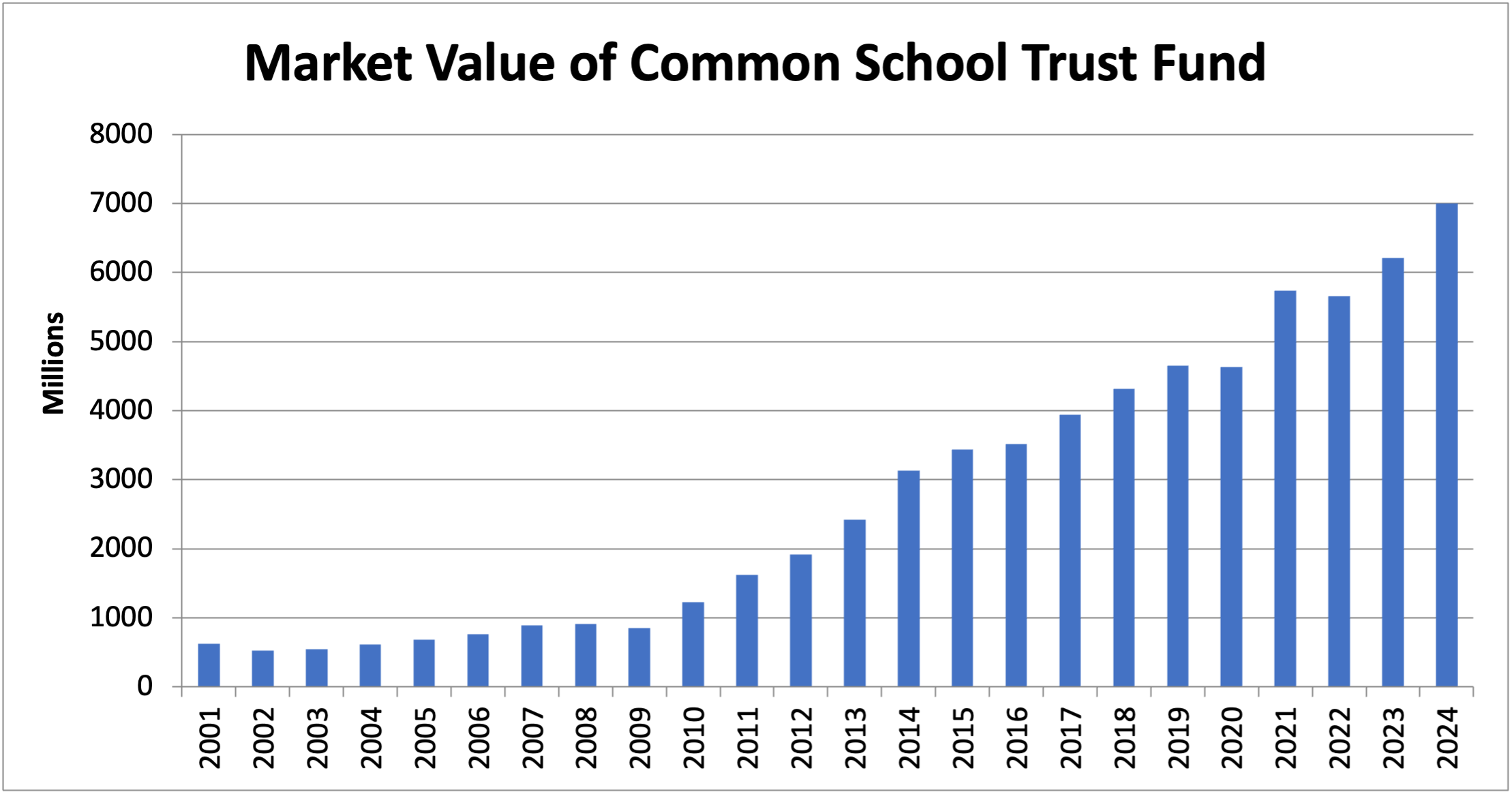
That investment return resulted in the Common School Trust Fund in biennium 2023-2025 distributing $500 million to North Dakota schools. That distribution is equivalent to $2,160 per student. Only Wyoming distributes more per student and that is primarily because Wyoming has far fewer students in the public schools.
FY2024 at a Glance
| Acres granted at statehood | 2.5 million (1889) |
|---|---|
| Surface acres currently held | ~700,000 |
| Mineral acres currently held | 2.6 million |
| FY2024 gross revenue | Awaiting consolidated public disclosure (oil & gas royalties + oil extraction tax dominant) |
| Common School Trust Fund market value (Jun 30, 2025) | $6,997,804,865 (2900% growth over 39 years) |
| Distribution to schools (2023–2025 biennium) | $500 million ($2,160 per student; second-highest per-pupil in nation) |
| 5-year total weighted return | 5.68% |
Data: ASTL FY2024 state report. Some figures are pending or carried from prior years where indicated.