
School Trust Lands
South Dakota
South Dakota is the field's clearest positive counter-example. The state entered the union in 1889 under the same Omnibus Enabling Act that admitted North Dakota, Montana, and Washington, and received the same two-section grant — sections 16 and 36 of every township for common schools. What set South Dakota apart was not the instrument. It was the architecture built around the instrument and the people who staffed it.
General William Henry Harrison Beadle, the territorial surveyor-general, insisted on writing a constitutional minimum sale price of ten dollars an acre for school sections at a time when adjacent federal land was being homesteaded for $1.25 or claimed free. Beadle understood that the children whose lands were being sold would never be in the room for the transaction, and he installed a price floor they would not need to be present to defend. The Beadle minimum is the load-bearing reason South Dakota retained most of its grant in usable condition while peer states hollowed theirs out at fire-sale rates. The architecture was then defended, decades later, by an elected Land Commissioner from the South Dakota Education Association who treated the office as Beadle had — as a fiduciary post for children who were not present. Margaret Bird's summary of him is plain: "every state can have a land commissioner like him." The point of the South Dakota example is not the individuals. It is that the framework was designed to work and then defended by institutions willing to do their job.
(as of June 2024)
On May 20, 1785, the Continental Congress provided land to support schools as each new state joined the union. “There shall be reserved the lot No.16, of every township, for the maintenance of public schools within the said township.” The federal school-land grant ultimately reached a national scale, and school-trust lands still span tens of millions of acres across the public-land states. Public accounting gathered by ASTL documents more than $100 billion in school-trust assets and more than $1 billion in annual distributions in the most recently reconciled national accounting; current fifty-state figures are being rebuilt state by state. However, few educators or members of the public know about school trust lands. Advocates for School Trust Lands is sharing this grand history of America’s founding vision for schools, hoping that over time Americans will know of school trust lands and their support for public schools.
On November 2, 1889, Congress granted statehood to South Dakota. Congress granted two sections of land, about 1280 acres, in each 6 square mile township in trust for the support of public schools. The schools received 2,813,511 acres and now hold over 760,000 surface acres and 5,200,000 mineral acres. These school trust lands are managed by the South Dakota Office of School and Public Lands. The statewide elected Commissioner is Brock Greenfield located in Suite 212 of the State Capitol in Pierre, South Dakota. Their mission is “to ensure efficient and superior management of school and endowment lands and trust funds owned and administered by the State of South Dakota.” The office is funded by state general fund, so all gross revenue goes to schools.
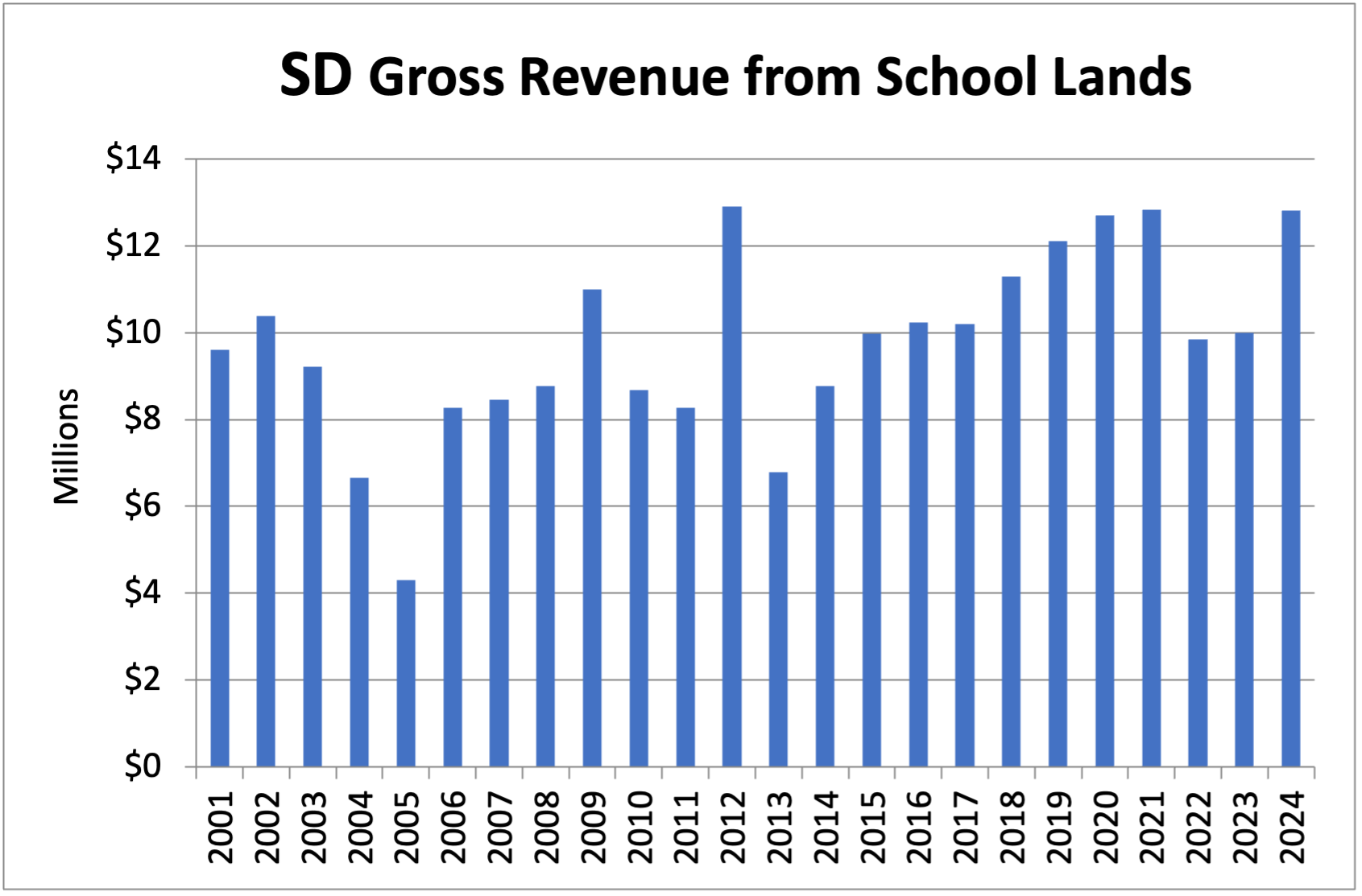
During Fiscal Year 2024, the school trust lands generated $215 million in gross revenue. The largest revenue sources are grazing and agriculture, but oil, gas, mineral and wind energy also contribute to a smaller degree. All renewable revenue is distributed along with half the oil and gas revenue. The other half of the oil and gas revenue is saved in the Permanent School Trust Fund.
Unlike other western states, South Dakota fortunately has no acres captured in national designations or by state parks or wilderness. This means all of their school acres can generate revenue. This is a tribute to their diligent management of the trust lands and to their topography.
The most significant accomplishments and challenges in the last two years include sending the second highest distribution since statehood to the public schools. There are 167,316 students and the distribution contributed $76.56 per student. Each spring agricultural leases and grazing leases are auctioned and leased for 5-year terms. At the last auction over 44 thousand acres were leased. All surface leases pay local property taxes to help support the communities within which they reside. Three new oil and gas tracts were leased so exploration could begin. In FY 2021 the first wind energy lease was executed.
At statehood, the Permanent Trust Fund was established with the intent of providing a continuous source of revenue for public schools, universities, and endowed institutions. Proceeds from the sale of land are to be deposited in the fund, which can be added to but never diminished. The interest revenue generated by the fund is apportioned to school districts, universities, and endowed institutions. Prior to the year 2001, the growth of the fund was based on land sales, mineral revenue and capital gains. In the 2000 general election, the voters changed the constitution and chose to allow the Commissioner of School and Public Lands to increase investment opportunities for the permanent school fund and retain the inflation percentage in the fund also known as the Consumer Price Index Adjustment or CPI.”
The permanent trust funds are managed by the South Dakota Investment Council located at 4009 West 49th Street, Suite 300 in Sioux, South Dakota 57106. They are available at (605) 362-2820. The funds are managed by professionals at the South Dakota Investment Council. The Chief State Investment Officer is hired by the council. The FY2024 market value of the Permanent School Trust Fund is $416,674,467 The 5-year time weighted return less fees was 6.8559%.
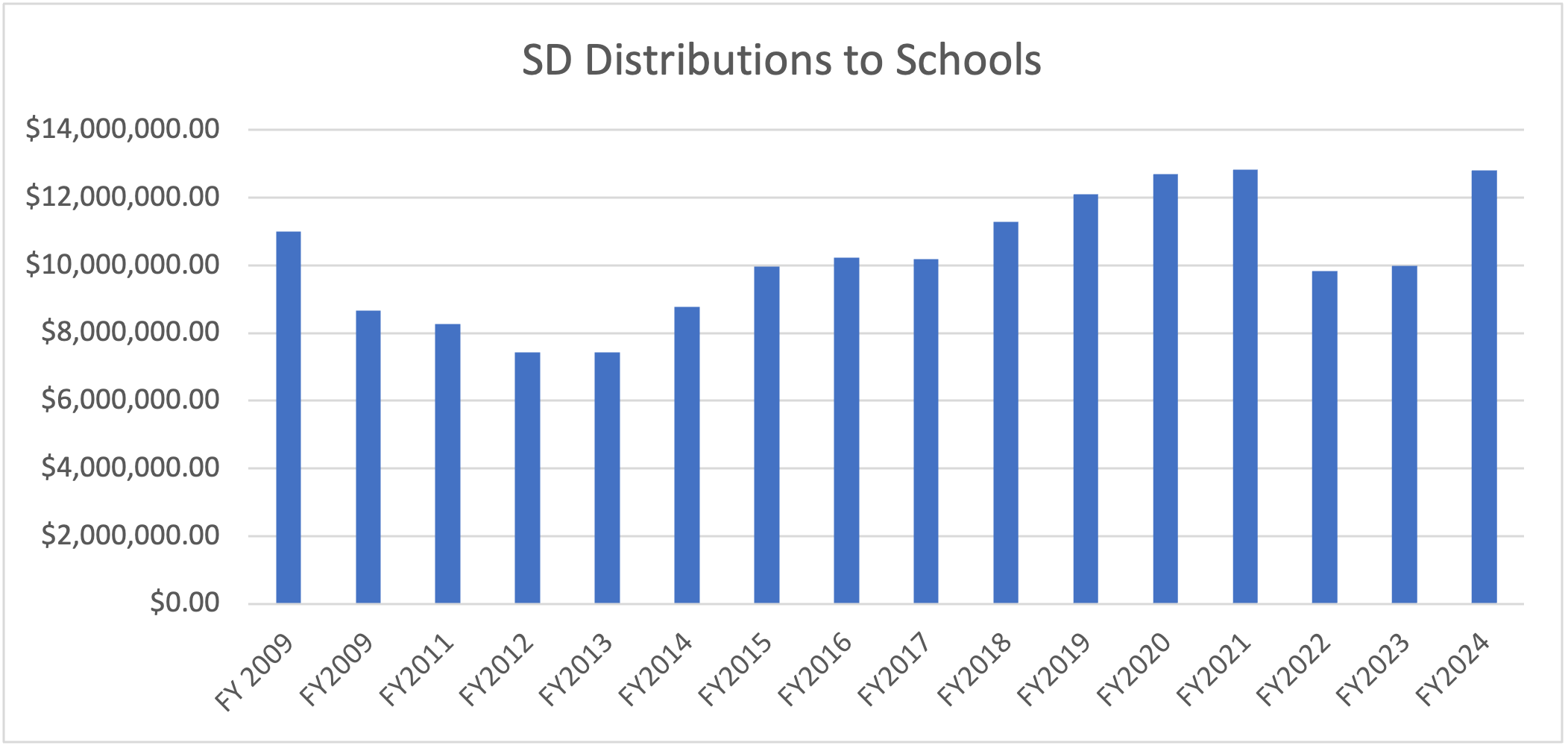
Wise investment of the school fund has resulted $12.8 million being distributed to South Dakota public schools in FY 2024, more than ever before except FY 2021.
FY2024 at a Glance
| Acres granted at statehood | 2,813,511 (Nov 2, 1889; two sections per township) |
|---|---|
| Surface acres currently held | 760,000+ |
| Mineral acres currently held | 5,200,000 |
| FY2024 gross revenue | $215 million |
| FY2024 PSF market value | $416,674,467 |
| FY2024 distribution to schools | $12.8 million ($76.56 per student across 167,316 students) |
| 5-year time-weighted return (less fees) | 6.8559% |
Data: ASTL FY2024 state report (Margaret Bird, final). Some figures are pending or carried from prior years where indicated.