
School Trust Lands
Utah
Utah is the state where Congress finally wrote the school trust the way it should have been written from the beginning. By 1894, Congress had watched seventy years of new-state behavior with the school sections and had learned what to expect. The Utah Enabling Act quadrupled the grant — sections 2, 16, 32, and 36 of every township — and wrote the permanent-fund architecture directly into federal text: the proceeds constitute a permanent fund; the interest only is expended; the land itself is reserved for school purposes only. The 1896 Utah Constitution then added a state-side guaranty, pledging that public school funds shall be guaranteed by the State against loss or diversion.
The architecture did not, by itself, save the trust. Eight decades of liquidation reduced the corpus, and in a single fourteen-month window in 1982–1983 the permanent State School Fund collapsed from $53.5 million to $18.6 million — a willful, directed seizure under cover of Jensen v. Dinehart. The architecture on paper said it could not happen. It happened anyway.
What turned Utah around was not a new architecture but a new constituency. Beginning with a 1989 Utah PTA resolution, parents, teachers, and school boards built the political base that produced the 1994 School and Institutional Trust Lands Management Act, then SITFO in 2014, then the Land Trusts Protection and Advocacy Office in 2018. The corpus grew sixty-fold under fundamentally the same constitutional architecture that had been in place during the 1983 collapse. Utah is the volume's central recovery case: the cleanest demonstration that a trust can be rebuilt when an organized constituency demands the trust be administered as a trust.
June 30, 2024
On May 20, 1785, the Continental Congress provided land to support schools as each new state joined the union. “There shall be reserved the lot No.16, of every township, for the maintenance of public schools within the said township.” The federal school-land grant ultimately reached a national scale, and school-trust lands still span tens of millions of acres across the public-land states. Public accounting gathered by ASTL documents more than $100 billion in school-trust assets and more than $1 billion in annual distributions in the most recently reconciled national accounting; current fifty-state figures are being rebuilt state by state. However, few educators or members of the public know about school trust lands. Advocates for School Trust Lands is sharing this grand history of America’s founding vision for schools, hoping that over time Americans will know of school trust lands and their support for public schools.
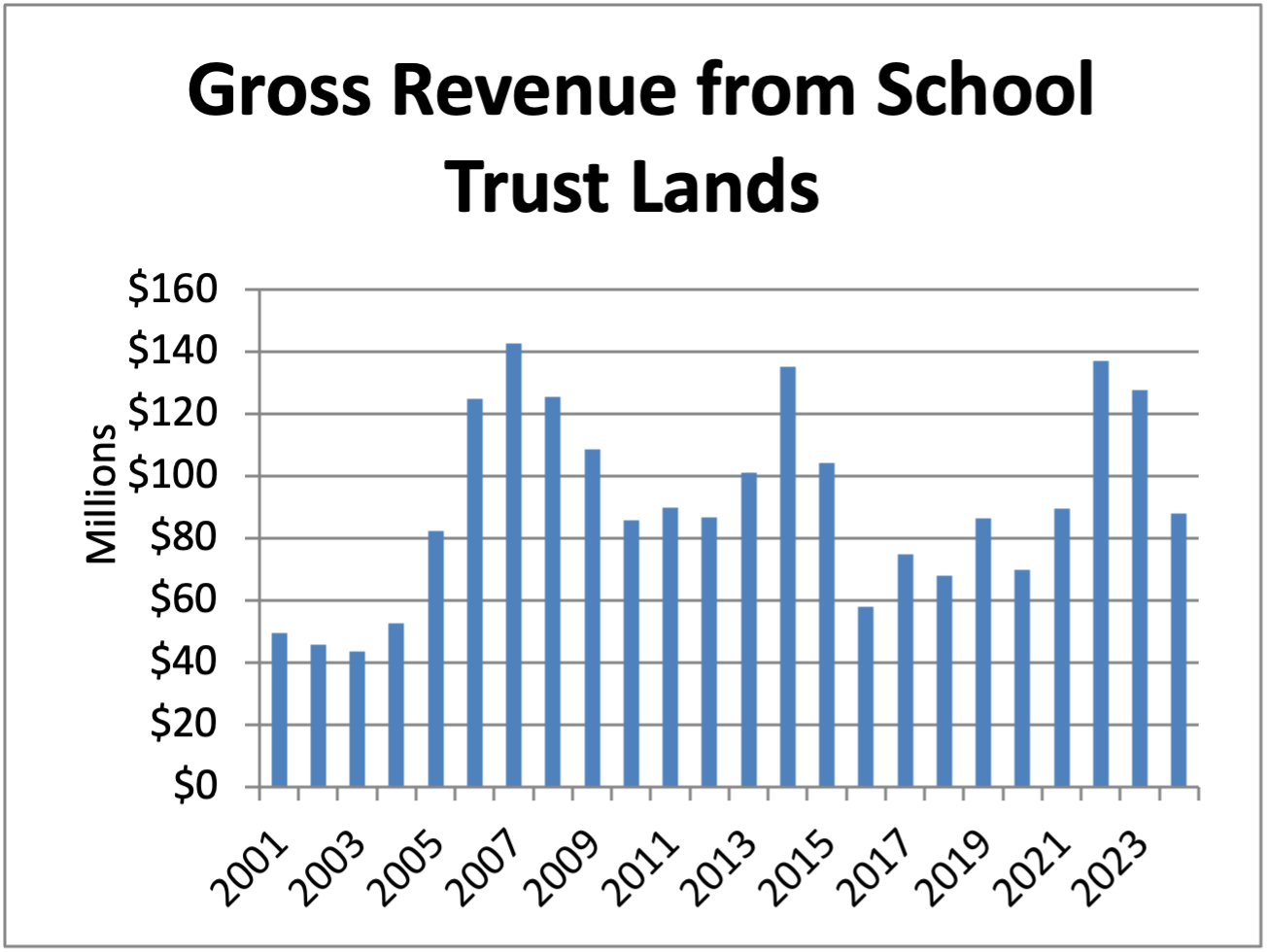
In 1894, due to the arid nature of Utah, Congress granted four sections per township for the support of schools. Schools received 6 million acres and now hold approximately 3.2 million surface acres and 4 million mineral acres. These school trust lands are managed by the School and Institutional Trust Lands Administration (Trust Lands Administration) (website: trustlands.utah.gov). Michelle E. McConkie is the Director, and there is a seven person Board of Trustees. The main office is located at 102 South 200 East, Suite 600 in Salt Lake City and is available by phone at 801-538-5100.
During Fiscal Year 2024, the school trust lands generated $88 million in gross revenue. The largest revenue sources for this fiscal year were royalties from oil and gas production, real estate development and sales, and surface land leases and grazing permits.
The most significant accomplishments and challenges in the last two years include the continued strong growth of the agency’s real estate development program, with particularly strong revenue from developments in Washington County (St. George City and Washington City specifically). In addition, the agency benefitted from strong oil and gas commodity prices. There were also several large land sales. The Trust Lands Administration is in the process of implementing the Dingell Exchange with the federal government, trading out lands in Wilderness Study Areas for land with mineral, renewable and development potential. The Trust Lands Administration continues to educate the public that these lands are not “state” lands but are lands held in trust by the agency for the benefit of each public school in the state which receives revenue and expends the funds according to a plan developed by parents, teachers and the principal in each school.
All net revenue generated from the lands is placed in the permanent State School Fund, where it is prudently and profitably invested by the School and Institutional Trust Fund Office (SITFO) (website https://sitfo.utah.gov). The Director and Chief Investment Officer is Peter Madsen. The office is located at 310 South Main, Suite 1250, in Salt Lake City. There is a board of five investment professionals selected by a nominating committee and appointed by State Treasurer Marlo Oaks, who serves as Chair. The board hires and fires the chief executive officer.
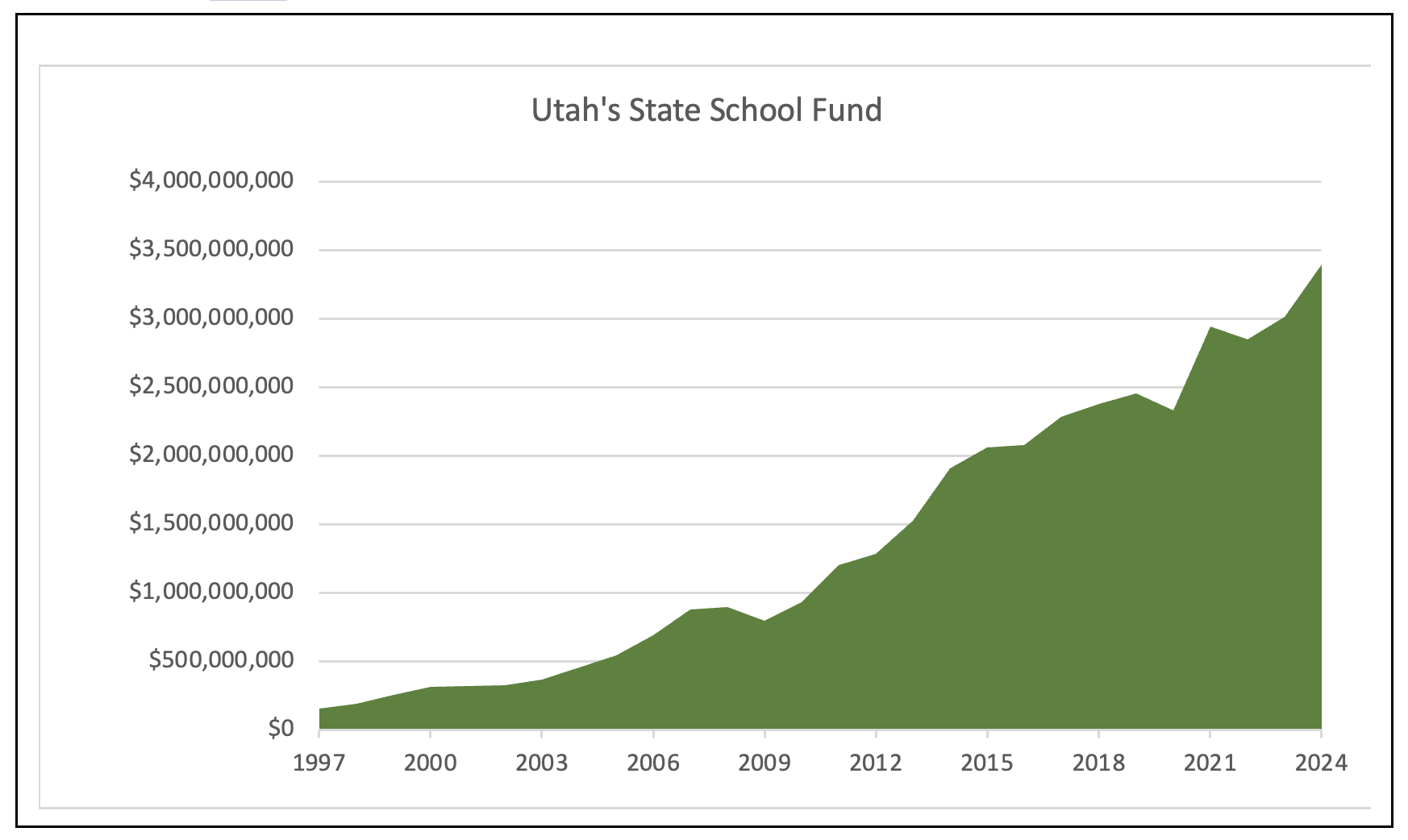
Wise and prudent investment along with profitable management of the school trust lands has led to rapid growth in the permanent State School Fund as seen in the graph above. The market value as of June 30, 2024 was $3,396,944,915. The five-year time weighted return net of fees is 6.67%--given the fact Texas is at 7.3 and their fund is more mature and has larger size advantages.
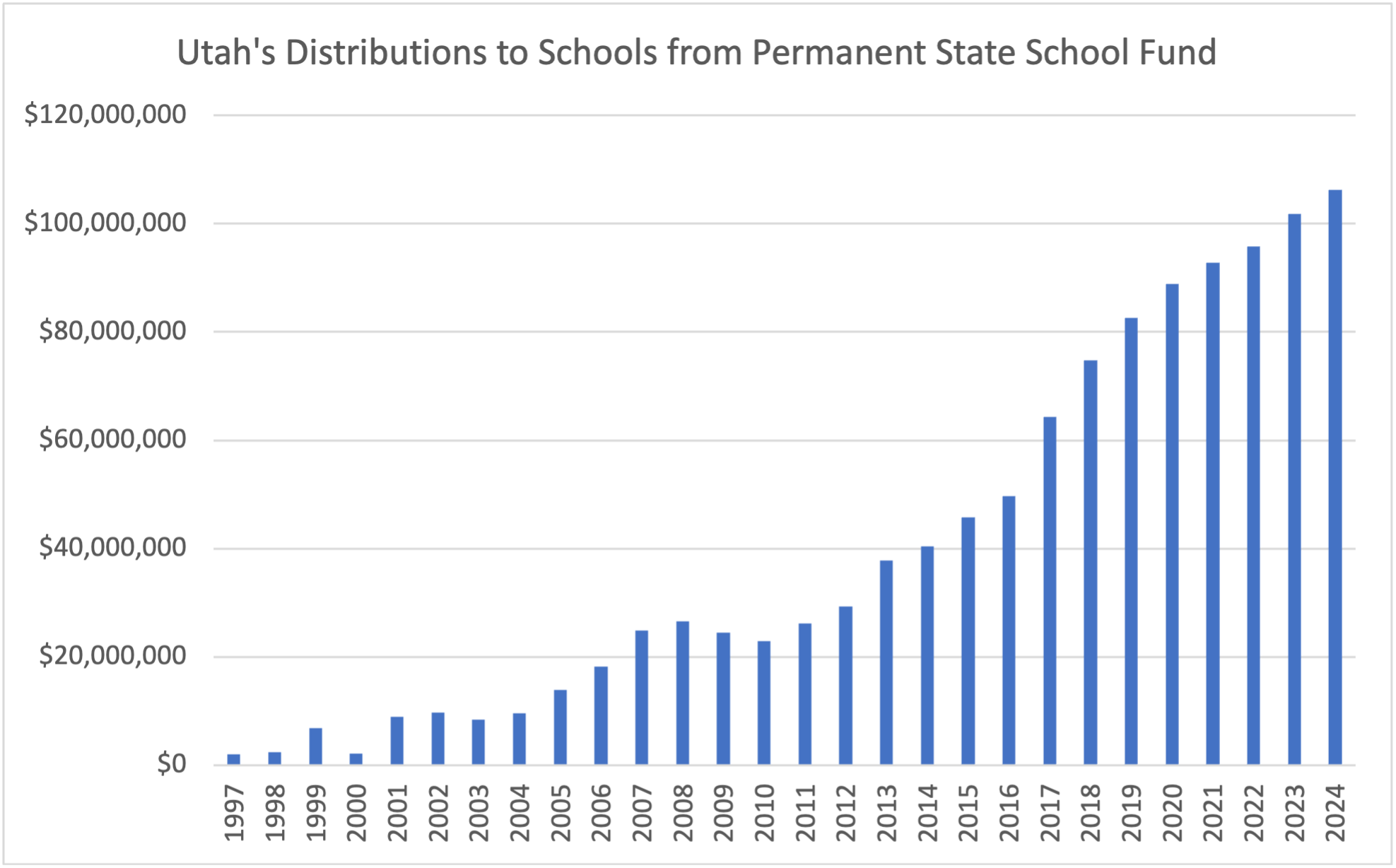
Annually, 4% of the average of the past 20 quarters of the market value of the permanent State School Fund is distributed to schools. The school distribution is primarily based on student population with a small amount of additional funding for smaller rural districts. A study was initiated by the School and Institutional Trust fund Office (SITFO) Director, Peter Madsen, to determine if the current distribution at 4% was meeting the requirement of charitable trusts to balance current distributions with future distributions. It was found that the current formula at 4% was favoring future students over currently enrolled students. So during the 2023 legislative session a resolution to amend the Utah constitution was passed to increase the distribution from 4% to 5%. That constitutional amendment was approved by voters in November of 2024 and will show up in higher distributions beginning next fiscal year.
During FY 2024, $106,221,909 was shared by every public school in Utah through the School LAND Trust Program to be used for academic improvement based on a plan developed by the school community council of elected parents, elected teachers, and the principal. These academic plans are developed based on each school’s data which is studied by the school community council. A plan is submitted and must have approval by each local school board prior to implementation. Additional information is available on the website: schools.utah.gov/schoollandtrust. Distributions were made through the State Board of Education and were administered by Paula Plant, the Director of the School Children’s Trust.
FY2024 at a Glance
| Acres granted at statehood | 6 million (1894; four sections per township) |
|---|---|
| Surface acres currently held | ~3.2 million |
| Mineral acres currently held | ~4 million |
| FY2024 gross revenue | $88 million |
| FY2024 PSF market value (Jun 30, 2024) | $3,396,944,915 |
| FY2024 distribution to schools | $106,221,909 (School LAND Trust Program) |
| 5-year time-weighted return (net of fees) | 6.67% |
Data: ASTL FY2024 state report. Some figures are pending or carried from prior years where indicated.