
Washington's constitutional convention of 1889 wrote the strongest education clause in any state constitution in the country. The drafters had been schoolteachers, farmers, and railroad lawyers; they had read the prior generation's failures across the older public-land states; and what they wrote is Article IX, section 1: "It is the paramount duty of the state to make ample provision for the education of all children residing within its borders, without distinction or preference on account of race, color, caste, or sex." Not a goal. Not an aspiration. A duty, ranked above all other state duties. That sentence has done real work in Washington school-finance litigation ever since, from Seattle School District No. 1 v. State in 1978 through McCleary v. State in 2012.
Washington belongs to the 2-section cohort: sections 16 and 36 of every township, doubled by Congress at the California admission of 1850 and held as the standard template through 1894. The state received roughly 2.4 million acres at admission. The Department of Natural Resources today manages about three million acres of state trust lands, and McCleary has become the spine of the state's contemporary school-finance debate — though it operates on the paramount-duty clause rather than on the trust grant itself. The Trust Land Performance Assessment has documented a twenty-five-year decline in real-dollar net revenue from state trust lands. The current distribution pattern routes funding to a limited number of selected schools rather than to all 2,278 Washington schools. The architecture is strong on paper. Whether the trust is being administered as a trust — for the beneficiary class the federal compact named — is the live question.
Key cases
- County of Skamania v. State, 102 Wn.2d 127, 685 P.2d 576 (1984) — The foundational Washington school-trust decision. The state supreme court held that Washington's federal land grants are real, enforceable trusts and that the State, as trustee, owes the beneficiaries the same fiduciary duties as a private trustee. Skamania set the rule the rest of the state's trust doctrine has been built on.
- Conservation Northwest v. Franz (Commissioner of Public Lands), 200 Wn.2d 8, 513 P.3d 752 (2022) — A unanimous 2022 Washington Supreme Court decision reaffirming Skamania across thirty-eight years and applying its trust framework to modern litigation. The court held that the federal Omnibus Enabling Act “creat[es] an enforceable trust with concomitant fiduciary duties on the State,” restating the Skamania rule that “[e]very court that has considered the issue has concluded that [these] are real, enforceable trusts that impose upon the State the same fiduciary duties applicable to private trustees.” On the beneficiary question, the court was emphatic: “The trustee owes a duty of undivided loyalty to trust beneficiaries (i.e., the essential purpose of the trust) designated by the settlor of the trust.” The Department of Natural Resources is “obligated as a trustee to manage state lands for the beneficiaries enumerated in the Enabling Act” — not for “all the people” of the state generally. Conservation Northwest's argument for a broader-beneficiary reading was rejected unanimously.
The 2022 reaffirmation matters for three reasons. First, the Enabling Act trust framework is live, binding 21st-century doctrine, not 1980s law — a unanimous state supreme court restated Skamania word-for-word and applied it to contemporary management decisions. Second, undivided loyalty runs to the enumerated beneficiaries, not to “the people” generally; Washington has now rejected the broader-beneficiary argument twice, once in 1984 and again in 2022. Third, the 2022 reaffirmation came in litigation brought by an environmental advocacy organization — Washington school-trust doctrine is being shaped in court by beneficiary-adjacent civic plaintiffs, not only by counties.
June 30, 2024
On May 20, 1785, the Continental Congress provided land to support schools as each new state joined the union. “There shall be reserved the lot No.16, of every township, for the maintenance of public schools within the said township.” The federal school-land grant ultimately reached a national scale, and school-trust lands still span tens of millions of acres across the public-land states. Public accounting gathered by ASTL documents more than $100 billion in school-trust assets and more than $1 billion in annual distributions in the most recently reconciled national accounting; current fifty-state figures are being rebuilt state by state. However, few educators or members of the public know about school trust lands. Advocates for School Trust Lands is sharing this grand history of America’s founding vision for schools, hoping that over time Americans will know of school trust lands and their support for public schools.
On November 11, 1889, Washington became a state, and Congress granted two sections of 640 acres each for the support of public schools in each township (six square mile area). Schools received 2,432,554 acres and now hold 1,795,564 acres. [1] These school trust lands are managed by the Department of Natural Resources (website: dnr.wa.gov). Hilary Franz is the Commissioner of Public Lands and is a statewide elected official. Their office is located in the Natural Resources Building at 1111 Washington Street SE, Olympia, WA 98504. Justin Schmal is over the K-12 Common School Lands and is available by phone at (360) 902-1697. The office retains a management percentage of the revenue earned from trust lands to cover their expenses.
“The Trust Land Performance Assessment has shown that over the past 25 years, total net revenue from state trust lands has declined in real dollars.” The Trust Land Initiative is addressing this decline and attempting to reverse its negative impact on school funding. The initiative will be built around three main strategies:
1. Legislative changes designed to increase the amount and the reliability of the revenue generated by the state trust lands portfolio;
2. Changes to Board of Natural Resources policies that improve trust asset management performance;
3. Updates to DNR operational business practices that increase the Department's efficiency and effectiveness in managing state trust assets.
The Initiative recognizes that the state has fiduciary duties to “generate revenue and other benefits for each trust by meeting DNR's trust management responsibilities. Those responsibilities include making state trust lands productive, preserving the corpus of the trust, exercising reasonable care and skill in managing the trust, acting prudently with respect to trust assets, acting with undivided loyalty to trust beneficiaries, and acting impartially with respect to current and future trust beneficiaries.” [2]
During FY2021, the school trust lands in Washington generated $53 million in gross revenue. The largest revenue sources were timber sales, agricultural leases and commercial real estate leases.
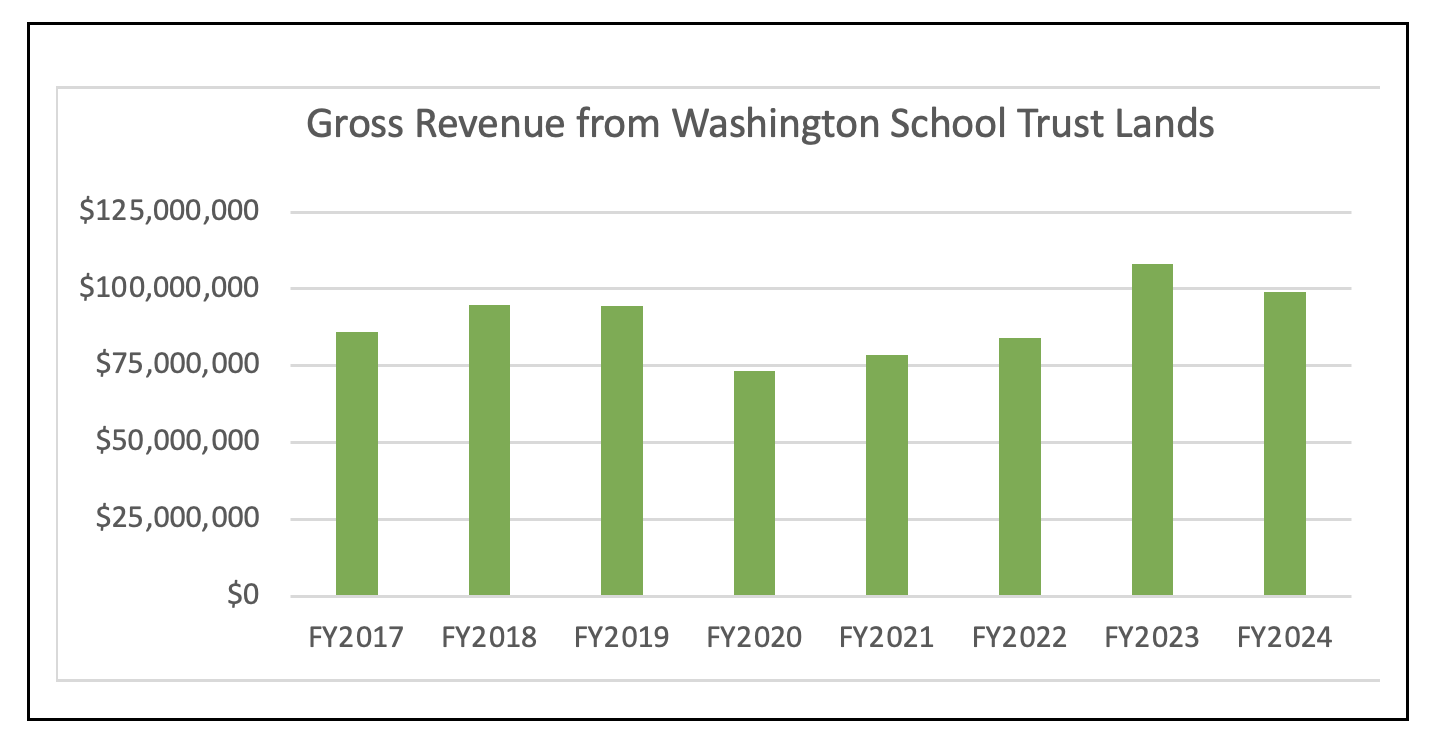
All net revenue generated from the land is deposited in the Common School Construction Account or the Common School Permanent Fund. All lease revenue, material sales of timber, gravel and similar products all contribute to the Common School Construction Account. This Account plus interest derived from the Permanent Common School Fund are used in the Common School Construction Fund exclusively for the purpose of financing the construction of facilities for the common public schools.
Revenue from all permanent transactions like land sales, sales of right-of-Way, and royalty from mineral production are invested annually in the Common School Fund. The permanent fund is invested along with the other permanent funds for the American Indian Scholarship Endowment, the Agricultural School, the Normal School (teacher colleges), the Scientific School and the State University.
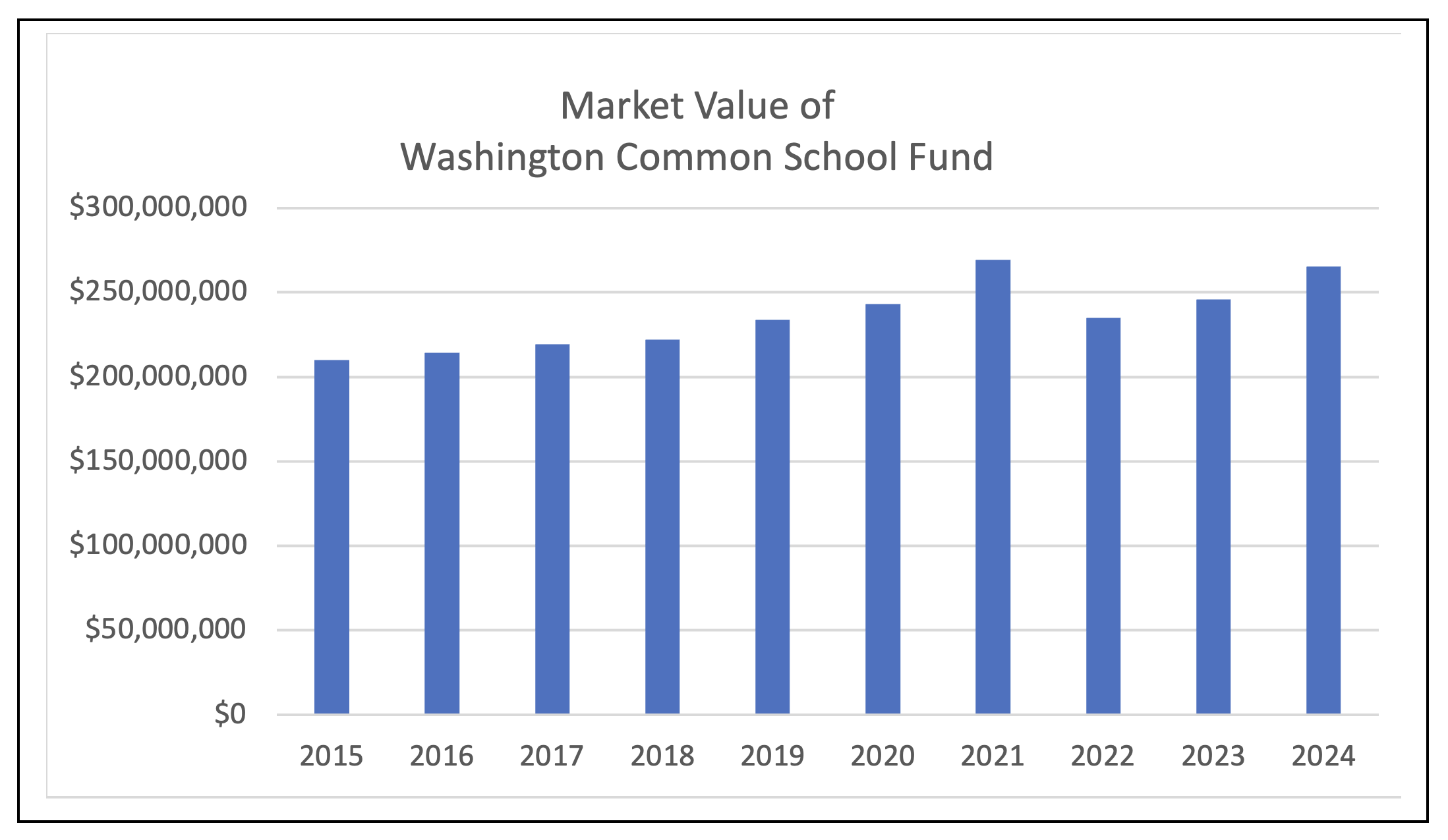
“Net investment position of the Permanent Funds decreased by $163.5 million during FY 2022.” In addition, the net investment position decrease “was due to a 266.6% increase in realized and unrealized losses from the previous fiscal year due to significant declines in market returns.” [3] The asset allocation for FY 2022 as 60.45% in bonds, 39.53% in equities, and 0.02% in Cash and cash equivalents.
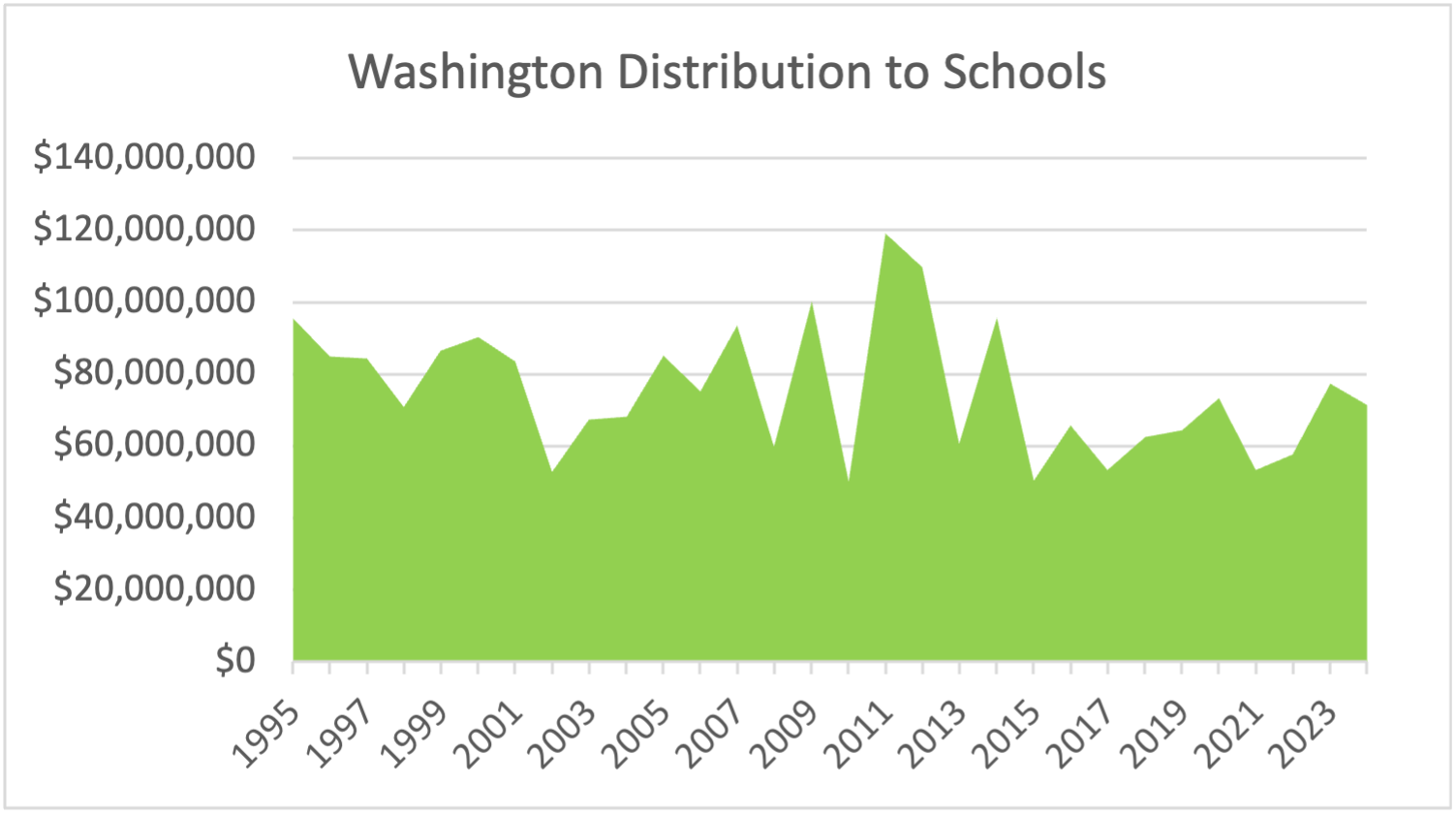
Annually, revenue is distributed to the Common School Construction Account from revenue derived primarily from school investment income but also from the school lands. Rather than benefitting all 2,278 Washington schools annually, Washington’s current distribution benefits a very limited number of selected schools.
The Distribution funds are allotted by the Superintendent of Public Instruction who allots appropriations and determines each district’s state funding assistance or match using formulas established in statute.
[1] This is 2019 data, the most recent available.
[2] Quotes in paragraph taken from dnr.wa.gov website.
[3] Washington State Investment Board FY 2022 Annual Report, p. 90.
FY2024 at a Glance
| Acres granted at statehood | 2,432,554 (Nov 11, 1889; two sections of 640 acres per township) |
|---|---|
| Surface acres currently held | 1,795,564 (2019 figure, most recent available) |
| Mineral acres currently held | Awaiting consolidated public disclosure |
| Gross revenue (FY2021 baseline) | $53 million (timber dominant; FY2024 figure data pending — net revenue declining in real dollars over 25 years) |
| FY2024 PSF market value | Awaiting consolidated public disclosure (net investment position decreased $163.5M in FY2022) |
| FY2024 distribution to schools | Awaiting consolidated public disclosure (Common School Construction Account; benefits a limited number of selected schools) |
| 5-year time-weighted return | Awaiting consolidated public disclosure |
Data: ASTL FY2024 state report. Some figures are pending or carried from prior years where indicated.