
School Trust Lands
Wisconsin
Wisconsin closes the 1-section era. From Ohio in 1803 through Wisconsin in 1848, every new state in the federal public-land system received one section per township — Section 16 alone, no Section 36. The federal text remained essentially unchanged across forty-five years and roughly fifteen admissions. Two years after Wisconsin's admission, Congress doubled the grant for California, and every state that followed received the doubled template. Wisconsin sits at the hinge.
What separates Wisconsin from the other 1-section states is not the federal floor. Ohio took the same text and, over two generations, depleted the resulting endowment almost beyond recognition. Wisconsin took the same text and built one of the strongest surviving school trusts in the country. The difference is Article X of the 1848 Wisconsin Constitution. Article X, section 2 made the principal irreducible. Article X, section 7 placed the Attorney General — the state's chief legal officer — inside the trustee body, on the theory that fiduciary duty, not political will, should define the standard of care. Article X, section 8 lodged sale and investment discretion in the trustees themselves.
The 1850s scandals diminished what the trust received per acre; they did not destroy the fund itself. The cash was forced into the school fund and walled off there. In 1871 the legislature pivoted from a land trust to a financial trust, authorizing the Board of Commissioners of Public Lands to lend the proceeds to Wisconsin municipalities and school districts. The program has run for more than 150 years without a single loan default. The Common School Fund principal today exceeds $1.6 billion. The FY 2026 distribution to Wisconsin public school libraries — a record $73.5 million — is the sole state aid for K-12 public school libraries, and more than ninety percent of districts rely on it entirely for library media budgets. Wisconsin is the case that shows the federal floor matters less than the state architecture built on top of it.
(as of June 2024)
On May 20, 1785, the Continental Congress provided land to support schools as each new state joined the union. “There shall be reserved the lot No.16, of every township, for the maintenance of public schools within the said township.” The federal school-land grant ultimately reached a national scale, and school-trust lands still span tens of millions of acres across the public-land states. Public accounting gathered by ASTL documents more than $100 billion in school-trust assets and more than $1 billion in annual distributions in the most recently reconciled national accounting; current fifty-state figures are being rebuilt state by state. However, few educators or members of the public know about school trust lands. Advocates for School Trust Lands is sharing this grand history of America’s founding vision for schools, hoping that over time Americans will know of school trust lands and their support for public schools.
Wisconsin received statehood on May 29, 1848. As a condition of statehood, 1.5 million acres were granted, in trust for the support of public schools. The majority of these lands have been sold to create the principal for a permanent school fund. This fund is to be exclusively used to support and maintain K-12 public schools, and “the purchase of suitable libraries and apparatus therefor.” [1] The school trust lands are part of a “sacred compact” between Wisconsin and Congress. The statehood act requires the state to act with undivided loyalty as it manages the school lands and funds in trust to support public schools. The founding fathers of Wisconsin had the prescience to provide for growth of the Common School Fund through the addition of “clear proceeds” of all fines, fees, and forfeitures that accrue to the state, including unclaimed property.
Today Wisconsin manages the remaining 5,190 acres of Common School Trust Lands located in remote rural areas of northern Wisconsin. Any revenue produced by these lands is deposited in the Common School Fund along with the fees, fines and forfeitures described above. The Wisconsin Common School Fund is managed by the Board of Commissioners of Public Lands. The investment returns from the Fund are distributed by the Wisconsin Department of Public Instruction (WPI) to the school districts. The DPI assures accountability.
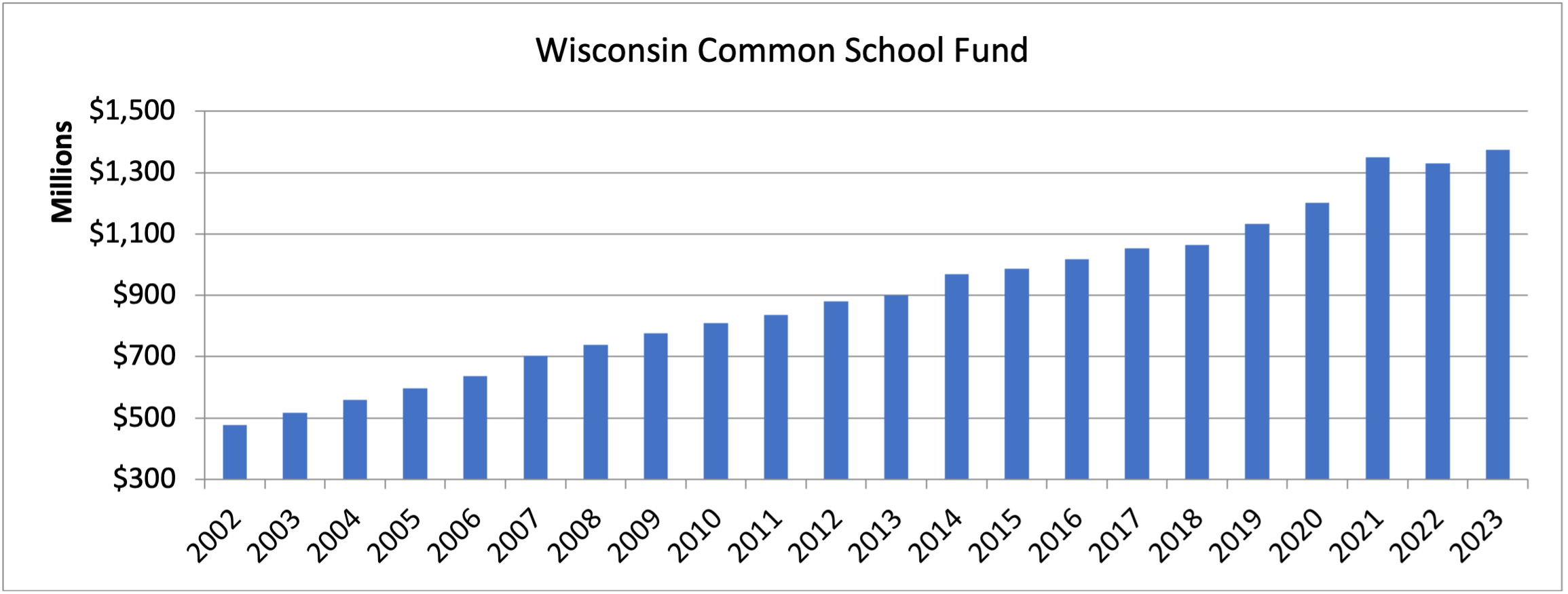
The above data was taken from the Biennial Reports of the Board of Commissioners of Public Lands. The Common School Fund earns money for libraries by making loans from the Fund to school districts and municipalities for public projects. For the past century and a half, Wisconsin has loaned money from the Common School Fund throughout the state of Wisconsin for public projects. Projects include economic development, school repairs and improvements, local infrastructure, and capital equipment and vehicles. In those 150 years, there has not been a single loan default. All the net interest from these loans is then distributed to public school libraries.
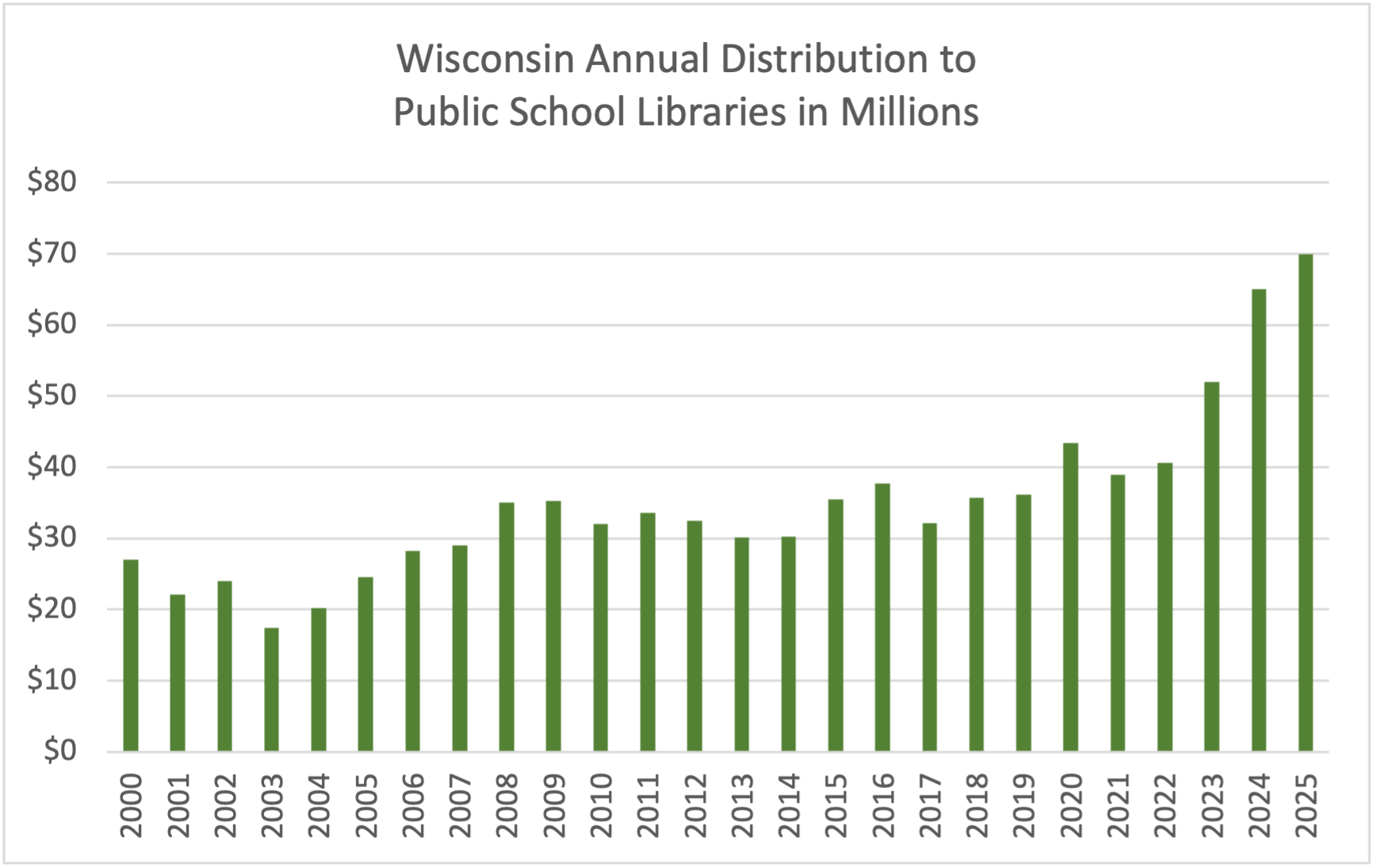
Interest paid on these loans is distributed for public school libraries. In FY 2025, $70 million was distributed. In most districts, these dollars represent the only funding available to purchase books, newspapers, periodicals, computers, web-based resources, and other library materials. The chart below shows the annual distributions to public school libraries obtained from the Wisconsin Department of Public Instruction website.
[1] Section 2, Article X, Wisconsin Constitution
FY2024 at a Glance
| Acres granted at statehood | 1.5 million (May 29, 1848) |
|---|---|
| Surface acres currently held | 5,190 (most sold to capitalize the Common School Fund) |
| Mineral acres currently held | Awaiting consolidated public disclosure |
| FY2024 gross revenue | Awaiting consolidated public disclosure (fund growth via fines, fees, forfeitures, unclaimed property; loans to municipalities) |
| FY2024 Common School Fund market value | Awaiting consolidated public disclosure |
| Distribution to public-school libraries (FY2025) | $70 million (Wisconsin uniquely funds public-school libraries) |
| 5-year time-weighted return | Awaiting consolidated public disclosure |
Data: ASTL FY2024 state report. Some figures are pending or carried from prior years where indicated.